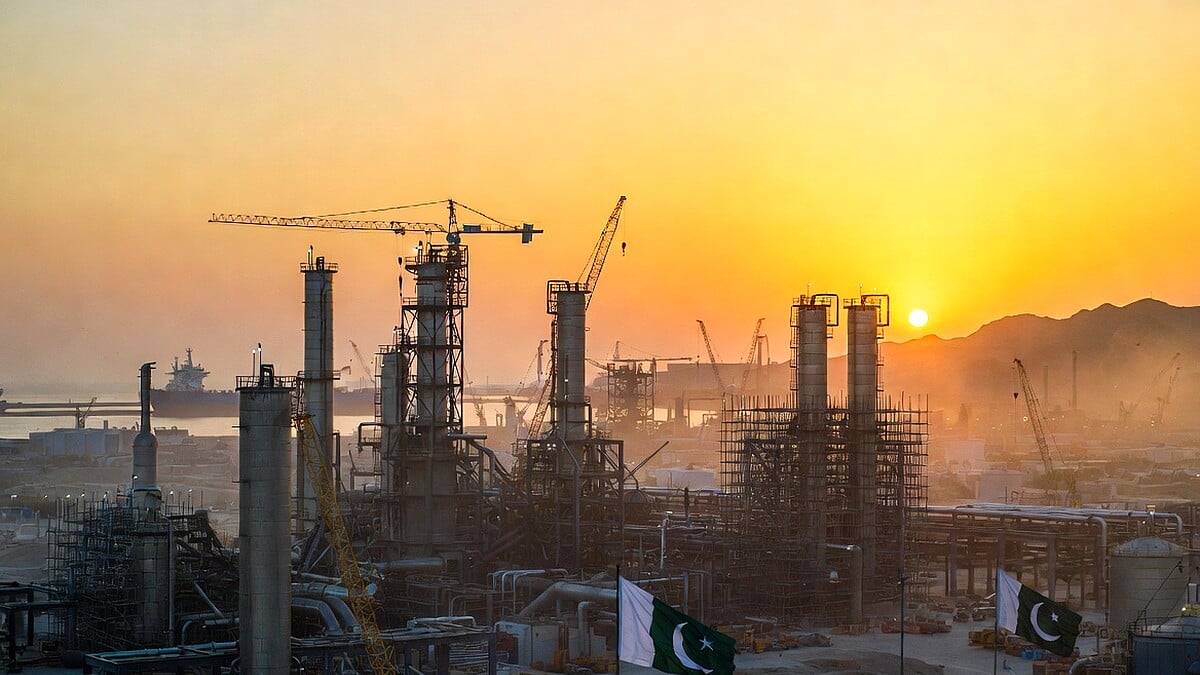




ISLAMABAD: Media reports have surfaced claiming a landmark economic breakthrough that could transform Pakistan’s energy security and slash billions from its crippling oil import bill.
Saudi Arabia has finalized plans for a $10 billion oil refinery in Gwadar according to multiple regional outlets and social media accounts circulating the development on April 10 and 11 2026.
Aramco is collaborating directly with Pakistan’s state-owned giants PSO OGDCL PPL and GHPL on the project.
Pakistani companies will shoulder 40 to 45 percent of the total investment underscoring deep local partnership.
The refinery is designed to process between 300 000 and 400 000 barrels of crude oil per day once operational.
Pakistan’s current combined refining capacity stands at roughly 450 000 barrels per day yet utilization rates remain low forcing heavy reliance on imports.
The country spent more than 17 billion dollars on oil and petroleum imports in the first ten months of the current fiscal year alone.
Recent global price spikes have already pushed monthly oil import bills toward 600 million dollars amid regional tensions.
Analysts warn that without new capacity every 10 dollar rise in global crude prices adds between 1.8 and 2 billion dollars annually to Pakistan’s import burden.
This Gwadar facility promises to process imported crude locally and drastically cut refined product imports that currently form the bulk of the energy bill.
The project was first announced in 2019 during high-level Saudi visits and revived through a 2023 memorandum of understanding.
Regional media and social platforms now report fresh momentum with government-backed tax incentives including a proposed 20-year tax holiday and full customs exemptions.
No official confirmation has emerged from Pakistani government sources or Saudi Aramco as of April 11 2026.
Yet the reports have ignited optimism across economic circles given Gwadar’s strategic location under the China-Pakistan Economic Corridor.
Completion could position Pakistan as a regional refining hub supplying both domestic needs and export markets.
Local equity participation of 40 to 45 percent would generate thousands of direct and indirect jobs in Balochistan.
It would also reduce foreign exchange outflows that have strained reserves in recent years.
Pakistan imports over 80 percent of its crude and refined fuel requirements exposing the economy to global volatility.
The new refinery’s capacity could meet a substantial portion of national demand and free up resources for other sectors.
Experts highlight that similar mega-refineries have historically boosted GDP growth by 1 to 2 percent in comparable economies through multiplier effects.
Bilateral ties between Riyadh and Islamabad would receive another major boost following recent defence and investment pacts.
The development comes as Saudi Arabia seeks diversified Asian markets while Pakistan pursues import substitution under its economic revival plan.
If realized the project would mark one of the largest single foreign investments in Pakistan’s energy sector.
Delays since 2019 had raised concerns but fresh tax breaks and full official support appear to have accelerated progress according to the circulating claims.
Economists project annual savings of several billion dollars once the refinery reaches full throughput.
This would ease pressure on the current account deficit and support rupee stability.
Gwadar’s deep-sea port infrastructure already in place provides ideal logistics for crude imports and product distribution.
The initiative aligns with broader CPEC goals of turning the port into an industrial and energy powerhouse.
While unverified the reports have triggered widespread discussion on social media with users hailing it as a potential game-changer for national energy independence.
Observers note that successful implementation could attract further Gulf investments into Pakistan’s hydrocarbon sector.
The refinery would also incorporate modern petrochemical capabilities expanding beyond basic fuel production.
Such integrated complexes typically yield higher returns and create downstream industries.
Pakistan’s five existing major refineries have struggled with outdated technology and low utilization highlighting the urgency of this upgrade.
With global demand for refined products rising the Gwadar project could capture export opportunities to landlocked Central Asian states.
Regional media outlets have amplified the story citing anonymous sources familiar with the negotiations.
The absence of immediate official statements has not dampened enthusiasm as similar past projects gained traction quietly.
If confirmed this would represent a historic milestone in Saudi-Pakistani economic cooperation dating back decades.
The potential reduction in oil import dependence could free fiscal space for infrastructure and social spending.
Analysts estimate the project timeline at five to six years from groundbreaking to commercial operations.
Interim measures such as renewed one-billion-dollar Saudi oil facilities are also reportedly under discussion.
Overall the reported finalization signals renewed confidence in Pakistan’s investment climate despite global uncertainties.
The development has drawn attention for its scale and timing amid Pakistan’s ongoing economic stabilization efforts.
Stakeholders await formal announcements that could unlock further details on financing and execution.
Until then the claims continue to fuel optimism about a brighter energy future for the country.