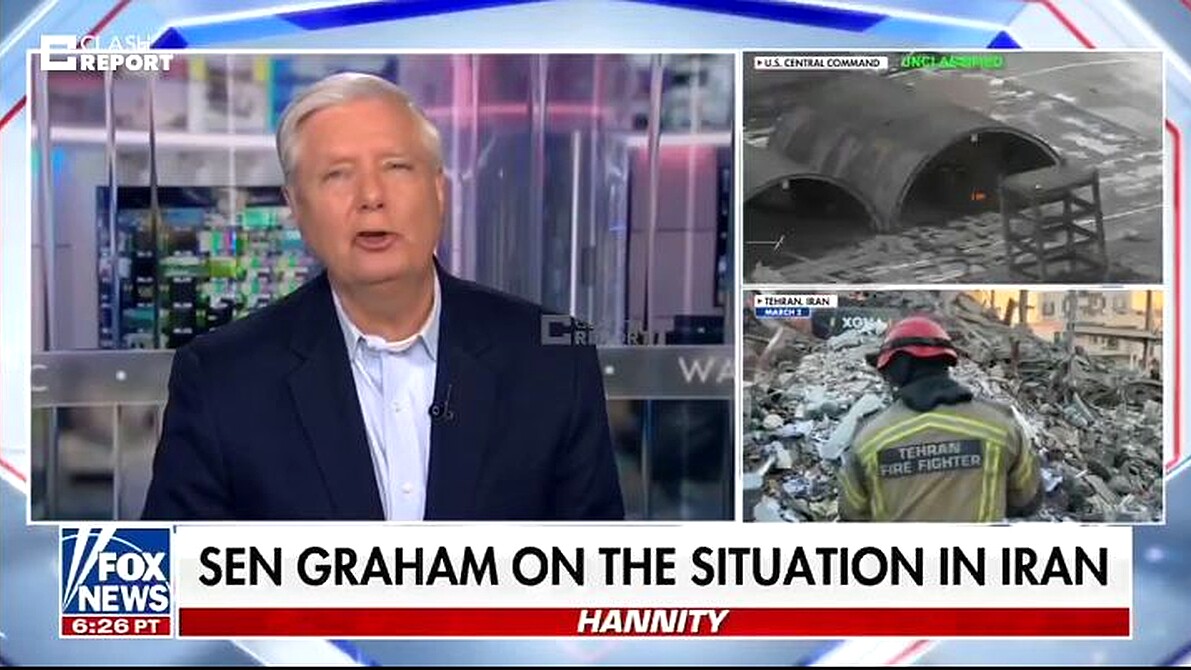
ISLAMABAD: In a stark revelation underscoring shifting alliances in the Middle East, US Senator Lindsey Graham has voiced profound disappointment over the United Arab Emirates’ refusal to join military efforts against Iran, despite its commitment to the Abraham Accords, raising questions about whether Washington can sustain a solitary confrontation with Tehran.
The Abraham Accords, signed in 2020 under US brokerage, normalized relations between Israel and several Arab states, including the UAE, Bahrain, Sudan, and Morocco, aiming to foster regional peace and counter Iranian influence.
Graham’s criticism emerged amid heightened tensions, following Israeli strikes on Iranian oil storage sites and reported Iranian attacks on Saudi Arabia, which prompted the evacuation of the US Embassy in Riyadh.
In a post on X, Graham highlighted Iran’s alleged role in killing seven Americans and terrorizing the region, urging Gulf allies to “step up” their involvement.
He specifically targeted Saudi Arabia and the UAE, questioning the viability of US defense agreements with nations unwilling to participate in mutual interests.
Data from the US State Department indicates that the Abraham Accords have facilitated over $10 billion in trade and investment between Israel and signatory states, yet military cooperation against Iran remains limited.
The UAE, a key signatory, has invested heavily in US weaponry, purchasing $23 billion worth of arms in 2020 alone, including F-35 fighter jets, as per the Stockholm International Peace Research Institute.
Despite this, UAE billionaire Khalaf Ahmad Al Habtoor rebuked Graham’s call, asserting in a widely shared statement that the Gulf does not need American protection and should avoid being dragged into external conflicts.
Al Habtoor emphasized that the UAE recognizes the Iranian threat but views the current escalation as a “dirty game” clashing powers at the region’s expense, without prior consultation with allies.
He further stated that Gulf nations will not sacrifice their sons for avoidable wars, prioritizing diplomacy over military engagement.
This response reflects broader Gulf apprehensions, as Iranian strikes have targeted desalination plants critical to the region, where the UAE derives 95 percent of its freshwater from such facilities, according to the World Bank.
Qatar, another Gulf state, imports 100 percent of its water needs via desalination, making any prolonged conflict economically devastating.
Oil prices have surged to $120 per barrel amid the Strait of Hormuz crisis, with Lloyd’s of London refusing to underwrite risks for vessels, disrupting global energy supplies that account for 21 percent of worldwide petroleum liquids.
The US Energy Information Administration reports that 20 million barrels of oil pass through the strait daily, underscoring the potential for widespread economic fallout.
Graham’s frustration extends to Saudi Arabia, where he warned of consequences if military support is not forthcoming, noting the kingdom’s capable forces yet reluctance to engage.
Saudi Arabia has deferred expanding the Abraham Accords post the Gaza conflict, signaling discontent with US prioritization of Israeli interests, as per regional analysts.
Russian Foreign Minister Sergey Lavrov revealed that Gulf states have sought Moscow’s mediation with Iran, highlighting a pivot towards multipolar diplomacy.
China, having brokered a 2023 détente between Iran and Saudi Arabia, continues to play a stabilizing role, preventing Houthi attacks on joint refineries.
Oman and Iraq have congratulated Iran’s new Supreme Leader Mojtaba Khamenei, further illustrating divergent paths from US-led coalitions.
The Sultan of Oman condemned US-Israeli actions at an Arab League conference, advocating non-participation in the conflict.
These positions contrast with the Abraham Accords’ intent to create a united front against Iran, which has instead exposed fractures in US-Gulf relations.
A report by the Carnegie Endowment for International Peace notes that Gulf states are diversifying partnerships, with UAE investments in Russian and Chinese ventures reaching $15 billion in 2025.
Pakistan, observing from afar, shares concerns over regional instability, as it relies on Gulf remittances totaling $30 billion annually from over 10 million expatriates, per the State Bank of Pakistan.
Any escalation could disrupt these flows, impacting Pakistan’s economy, which saw a 10 percent dip in remittances during previous Middle East crises.
Iran’s resilience, backed by the Islamic Revolutionary Guard Corps, has withstood sanctions imposing $1 trillion in economic losses since 2018, according to the International Monetary Fund.
Tehran’s proxy networks, including Hezbollah and Houthis, have expanded operations, with over 200 attacks on shipping since October 2023, as tracked by the US Naval Forces Central Command.
Israel’s strikes on 30 Iranian fuel depots have filled Tehran’s skies with black clouds, yet Graham urged caution in target selection to avoid global oil disruptions.
The senator’s diplomatic post on X appreciated Israel’s actions but advised restraint, reflecting internal US debates on escalation.
Al Habtoor’s retort accused the US of treating Gulf lives as collateral in pursuit of a “new Middle East” for profit, echoing sentiments that America might withdraw post-conflict to sell more arms.
Qatari influencers have amplified this, warning of a “Greater Israel Project” at Arab expense.
The UAE’s stance, as a hub for global trade with Dubai Ports handling 15 million containers annually, prioritizes economic stability over military adventures.
Data from the World Trade Organization shows UAE trade volumes at $600 billion in 2025, vulnerable to war-induced disruptions.
Saudi Vision 2030, aiming for non-oil GDP growth to 65 percent, could falter amid conflict, with projected losses of $200 billion, per economic forecasts.
Graham’s threats hint at potential US withdrawal from defense pacts, like the 1991 agreement with Saudi Arabia, which has seen over 5,000 US troops stationed there.
Yet, Gulf states’ hedging towards Russia and China, with Saudi Arabia joining BRICS in 2024, diminishes US leverage.
Iran’s new leadership under Khamenei signals continuity in resistance, with nuclear advancements reaching 60 percent uranium enrichment, close to weapons-grade, as per the International Atomic Energy Agency.
The US faces isolation, as European allies like France and Germany advocate diplomacy, with EU trade with Iran at €5 billion annually.
Pakistan’s Foreign Ministry has called for de-escalation, aligning with OIC resolutions urging restraint.
The refusal by Abraham Accords partners like the UAE underscores a recalibration, where economic interdependence trumps ideological alliances.
As tensions simmer, the prospect of a lone US confrontation with Iran grows, potentially reshaping Middle Eastern geopolitics for decades.