ISLAMABAD: The Pakistan Air Force (PAF) on Monday successfully concluded the ‘Golden Eagle’ training exercise, a major operational drill that emphasized artificial intelligence-enabled operations and the integration of newly developed indigenous technologies. Conducted in the Southern Air Command’s area of responsibility, the exercise aimed to validate the force’s combat readiness and operational agility through synchronized use of its full combat potential. According to the Inter-Services Public Relations (ISPR), the drill underscored Pakistan’s focus on modern warfare capabilities in response to dynamic security challenges in the region.
The exercise operated under a unified command and control framework from the Next-Generation All-Domain Command and Control Centre at Air Headquarters in Islamabad. This centralized approach enabled seamless coordination across air assets, ensuring efficient decision-making during complex scenarios. The PAF adopted a two-force construct, simulating realistic adversarial engagements to test responsiveness and integration of diverse platforms. Such structured simulations are essential for maintaining preparedness in contested environments.
A primary focus of ‘Golden Eagle’ was AI-enabled and net-centric operations, which facilitate real-time data sharing and decision superiority. The drill incorporated indigenous niche, disruptive, and smart technologies developed locally to reduce reliance on foreign systems. This aligns with broader national efforts to bolster self-reliance in defense, particularly in response to evolving regional security dynamics that demand rapid adaptation to emerging threats.
Participants operated within a robust integrated air defence system, combining kinetic strikes with non-kinetic domains including cyber, space, and electromagnetic spectrum operations. This multi-domain fusion represents a shift toward holistic warfare strategies, where dominance in one domain supports advantages in others. The approach enhances resilience against sophisticated adversaries employing hybrid tactics.
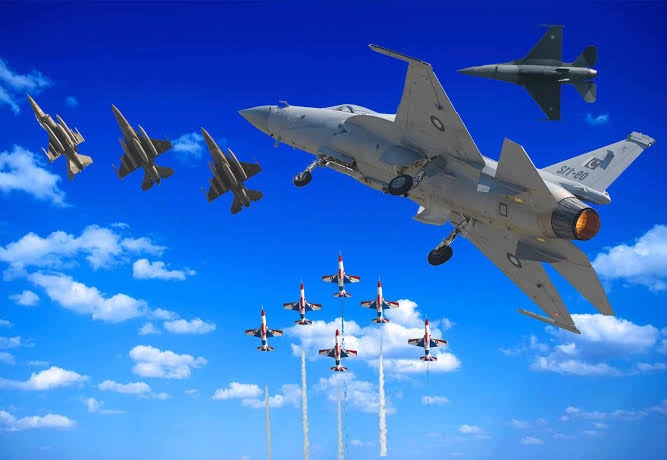
The kinetic phase featured swing-role combat aircraft capable of first-shoot, first-kill engagements using long-range beyond visual range air-to-air missiles, extended-range stand-off weapons, and precision strike munitions. These platforms received support from airborne early warning and control systems as well as air-to-air refuellers, extending operational reach and endurance. Such capabilities ensure sustained high-intensity operations over contested airspace.
The key highlight of the exercise was manned-unmanned teaming, where drones and loitering munitions operated alongside manned aircraft in highly contested, congested, and degraded environments. This integration validated the PAF’s capacity to execute high-tempo missions by leveraging autonomous systems for reconnaissance, targeting, and suppression. Manned-unmanned collaboration marks a significant advancement in modern air warfare, improving situational awareness and reducing risks to human pilots.
By incorporating these elements, ‘Golden Eagle’ demonstrated the PAF’s ability to synchronize advanced technologies with traditional assets. The exercise tested operational concepts in realistic conditions, confirming effectiveness against potential threats that involve electronic jamming, cyber intrusions, and multi-domain challenges. Indigenous innovations played a central role, highlighting progress in local research and development within the aerospace sector.
The successful execution reaffirms the Pakistan Air Force’s commitment to sustaining high operational preparedness. It reflects a strategic emphasis on leveraging indigenous innovation to address emerging and future security challenges effectively. As regional tensions persist, such drills strengthen deterrence and operational credibility.
The exercise also signals the PAF’s alignment with global trends in air power, where artificial intelligence and unmanned systems are increasingly pivotal. Through repeated validation of these capabilities, the force positions itself to counter asymmetric and conventional threats with greater efficiency.