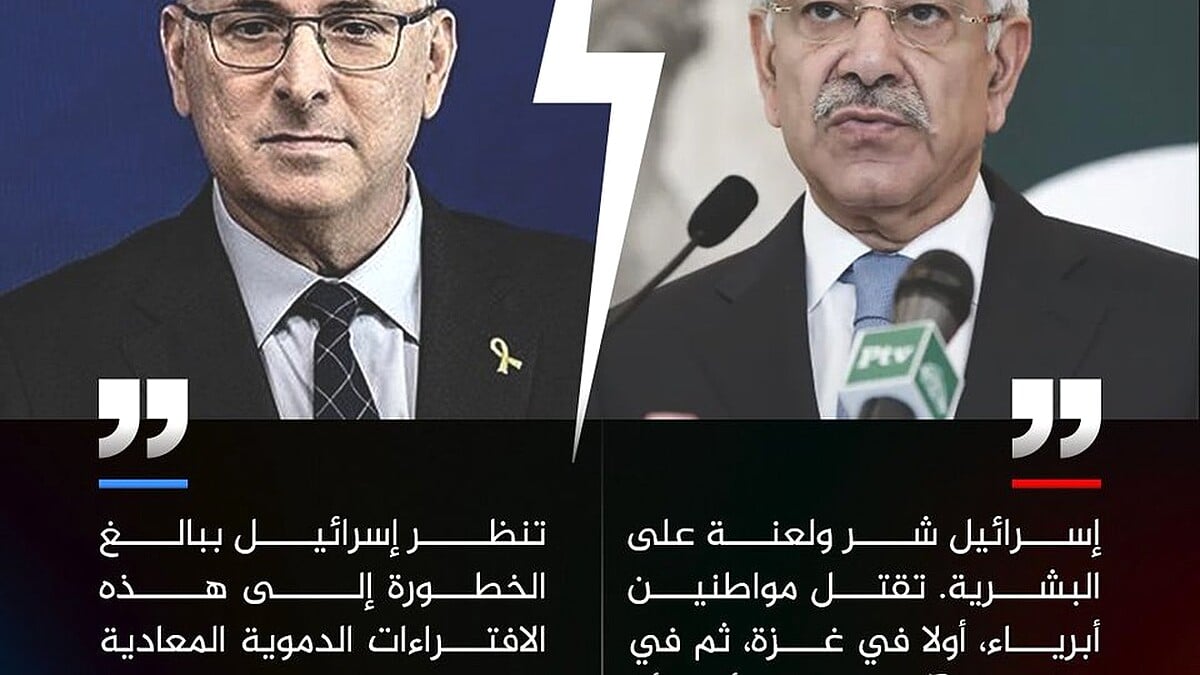




ISLAMABAD: X administration removed Defence Minister Khawaja Muhammad Asif’s post labelling Israel a cancerous state and curse for humanity under its hate speech policy.
The controversial post triggered immediate backlash from Israeli Prime Minister Benjamin Netanyahu’s office and Foreign Minister Gideon Sa’ar, who described the remarks as outrageous antisemitic blood libels calling for Israel’s annihilation.
Regional media reports and multiple international outlets confirmed the post’s content before its removal, noting that Asif accused Israel of committing genocide in Lebanon while US-Iran peace talks were hosted in Islamabad.
In the now-deleted post, Asif wrote that Israel is evil and a curse for humanity, with innocent citizens being killed first in Gaza, then Iran and now Lebanon, bloodletting continuing unabated.
He further prayed that those who created this cancerous state on Palestinian land to rid themselves of European Jews burn in hell.
Israeli Prime Minister’s office stated that such a call for Israel’s destruction cannot be tolerated from any government, especially one claiming neutral arbiter status in regional peace efforts.
Foreign Minister Sa’ar condemned the language as blatant antisemitism, warning it undermines any credibility Pakistan seeks in mediating West Asia tensions.
The incident occurred as Pakistan positioned itself as a facilitator in ongoing US-Iran ceasefire discussions, drawing global attention to Islamabad.
International coverage, including reports from The Times of Israel, Times of India, Firstpost and Anadolu Agency, highlighted the diplomatic flashpoint and questioned Pakistan’s mediation role.
Regional outlets in Pakistan and Urdu media echoed claims that the post was not self-deleted by Asif but removed by X platform administrators for violating hate speech guidelines.
This aligns with X’s enforcement patterns on content targeting Israel, as noted in several user observations and local analyses.
Pakistan has no formal diplomatic ties with Israel and maintains strong support for the Palestinian cause, a position repeatedly affirmed by Asif in past statements.
Defence Minister Asif has previously criticised Israeli actions in Gaza, Iran and Lebanon, accusing Zionism of posing threats to the broader Muslim world.
The latest episode comes amid Israeli airstrikes on Lebanon that reportedly killed hundreds, according to casualty figures cited in multiple Middle East reports.
Over 300 deaths were linked to recent operations in Lebanon, with accusations of disproportionate force dominating regional discourse.
Pakistan’s government has not issued an official clarification on the deleted post, leaving room for speculation on internal diplomatic considerations.
The removal raises fresh questions about social media platforms’ content moderation policies, especially when high-level officials from non-aligned nations voice strong criticism of Israel.
Analysts note that such incidents highlight the delicate balance Pakistan must maintain while engaging in sensitive mediation between the United States and Iran.
With eyes of the world focused on Islamabad’s peace efforts, the controversy could complicate future diplomatic initiatives in West Asia.
Pakistan’s consistent stance against Israeli policies in occupied territories has long been part of its foreign policy framework.
Figures from ongoing conflicts indicate thousands of civilian casualties across Gaza, Lebanon and related escalations, fuelling global debates on humanitarian law violations.
Asif’s rhetoric, though removed, resonated with segments of public opinion in Pakistan and the wider Muslim world, where support for Palestine remains overwhelming.
The episode underscores tensions between free expression on social platforms and international diplomatic sensitivities.
X, formerly Twitter, has faced repeated accusations of selective enforcement regarding content critical of Israel versus other geopolitical issues.
No official statement has emerged from Pakistan’s Foreign Office on the platform’s action or Israeli reactions.
The development adds another layer to already strained narratives surrounding Middle East peace prospects.
Observers suggest the incident may prompt greater caution in official social media communications from Pakistani leadership during sensitive periods.
With over 1,200 casualties reported in recent Lebanon strikes according to some regional tallies, the humanitarian dimension continues to dominate discussions.
Pakistan’s mediation role, if sustained, could bring significant geopolitical benefits, as previously highlighted by Asif himself in public addresses.
Yet the latest social media controversy risks casting shadows on Islamabad’s neutrality claims.
The full text of the deleted post, widely circulated before removal, left little ambiguity about its strong wording and intent.
International media coverage amplified the story within hours, turning a single post into a brief diplomatic row between nations without direct relations.
As Pakistan navigates complex regional dynamics, such episodes test the boundaries of public diplomacy in the digital age.