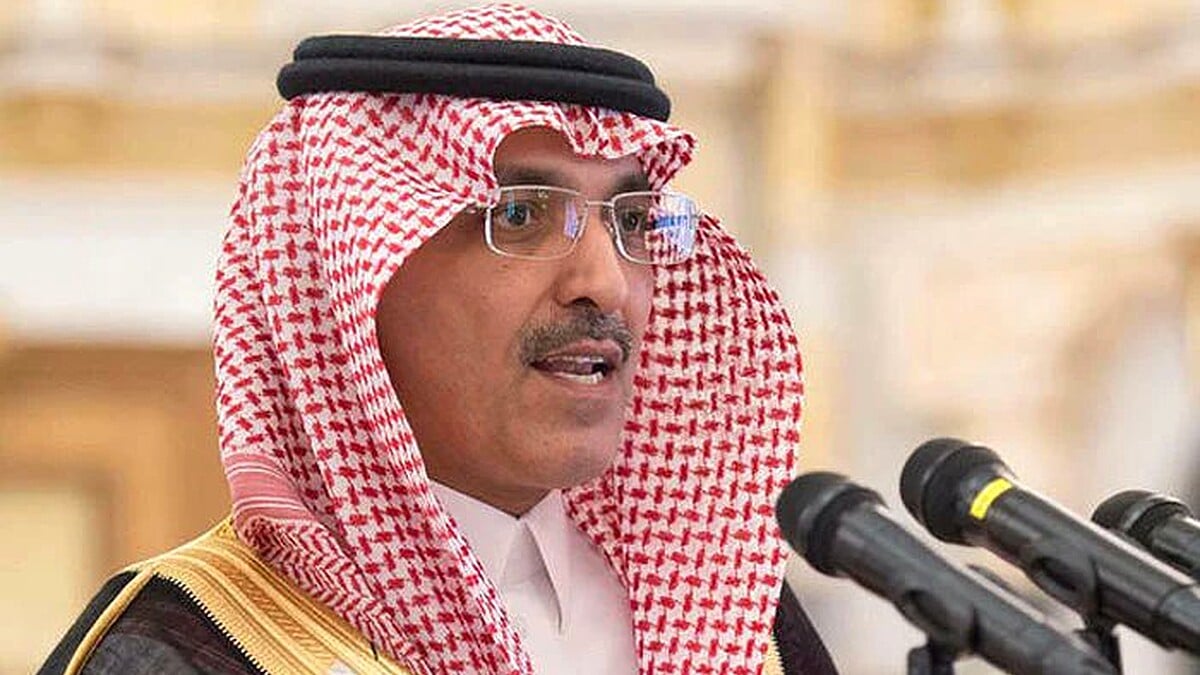




ISLAMABAD: Saudi Finance Minister Mohammed Al-Jadaan landed in Islamabad on Friday, triggering intense speculation over potential new financial lifelines and the revival of stalled multibillion-dollar projects between the two brotherly nations.
The high-profile Saudi official, received by Pakistan’s Finance Minister Muhammad Aurangzeb and Saudi Ambassador Nawaf Saeed Al-Malki, is expected to guide sensitive negotiations on economic cooperation amid shifting regional alignments.
Sources close to the talks indicate that discussions may centre on extending further financial assistance worth up to $5 billion, building on Saudi Arabia’s historical role as a key backstop for Pakistan’s economy during crises.
Pakistan has previously sought conversion of an existing $5 billion Saudi deposit into a longer-term 10-year facility with favourable terms, alongside expansion of the deferred oil payment facility from $1.2 billion to $5 billion with extended repayment periods.
Regional media reports suggest the visit could accelerate activation of pending Saudi projects, including potential revival of the long-stalled $12 billion oil refinery and petrochemical complex originally envisioned under earlier investment pledges.
Such a revival would significantly ease Pakistan’s heavy reliance on imported petroleum products, which continue to strain foreign exchange reserves and contribute to balance-of-payments pressures.
Analysts point to the recent Strategic Mutual Defense Agreement signed in September 2025 as a catalyst for enhanced economic deliverables, with the pact framing any aggression against one as aggression against both.
This defence pact has already opened pathways for deeper military cooperation, including joint exercises, intelligence sharing and potential stationing of Pakistani forces in Saudi Arabia.
Economically, the alignment is expected to unlock investment flows in energy, mining and infrastructure sectors critical for Pakistan’s growth.
Saudi interest in Pakistan’s mineral resources remains strong, particularly in the Reko Diq copper-gold project in Balochistan, one of the world’s largest undeveloped deposits.
Manara Minerals, backed by Saudi Public Investment Fund and Ma’aden, has shown interest in acquiring stakes, with earlier indications of a possible 15 percent share valued around $540 million in related discussions.
Broader Saudi investment appetite for Pakistan has hovered around $10 billion in recent signals, shifting towards business-to-business models rather than direct crisis financing.
This includes potential participation in refinery expansions estimated at $2 billion for key facilities, alongside solar energy and technology collaboration leveraging Pakistan’s growing IT talent pool.
Pakistan’s Finance Ministry has highlighted progress on privatisation of state-owned enterprises, including airports in Islamabad, Lahore and Karachi, as attractive avenues for Saudi capital.
Al-Jadaan’s visit comes against the backdrop of Pakistan’s ongoing efforts to stabilise its economy under International Monetary Fund programmes, with foreign reserves remaining vulnerable to external shocks.
In past instances, Saudi support through central bank deposits and deferred oil payments helped Pakistan avert default risks, providing critical breathing space.
The current engagement builds on multiple high-level meetings, including those on the sidelines of the World Economic Forum in Davos earlier this year.
Regional reports from Pakistani and Saudi media outlets authenticate claims of an impending economic cooperation framework, potentially to be formalised during a future visit by Saudi Crown Prince Mohammed bin Salman.
Such a framework would encompass energy security, mining development, digital trade facilitation and enhanced private sector partnerships.
Speculation also swirls around gold mining opportunities and reactivation of other stalled initiatives in line with the evolving defence-economic pact.
Pakistan’s petroleum imports remain a major burden on its current account, making expanded Saudi oil facilities a high-priority agenda item.
Officials have expressed optimism that the visit will inject fresh momentum into bilateral ties, reinforcing Saudi Arabia’s position as a strategic partner.
The arrival of Al-Jadaan underscores the deepening multidimensional relationship, blending security assurances with economic resilience building.
Observers note that timely Saudi inflows could bolster investor confidence and support Pakistan’s reform agenda, including phased privatisation drives.
With regional geopolitics in flux, the Islamabad talks carry implications beyond bilateral trade, potentially reshaping investment landscapes across South Asia and the Gulf.
Data from past engagements show Saudi pledges once reaching $25 billion over two years, though implementation has varied with global oil dynamics and domestic priorities.
The current high-stakes visit is viewed as a litmus test for translating strategic defence pacts into tangible economic dividends for Pakistan’s 240 million population.
As meetings unfold behind closed doors, expectations run high for announcements that could mark a new chapter in Pakistan-Saudi brotherhood.