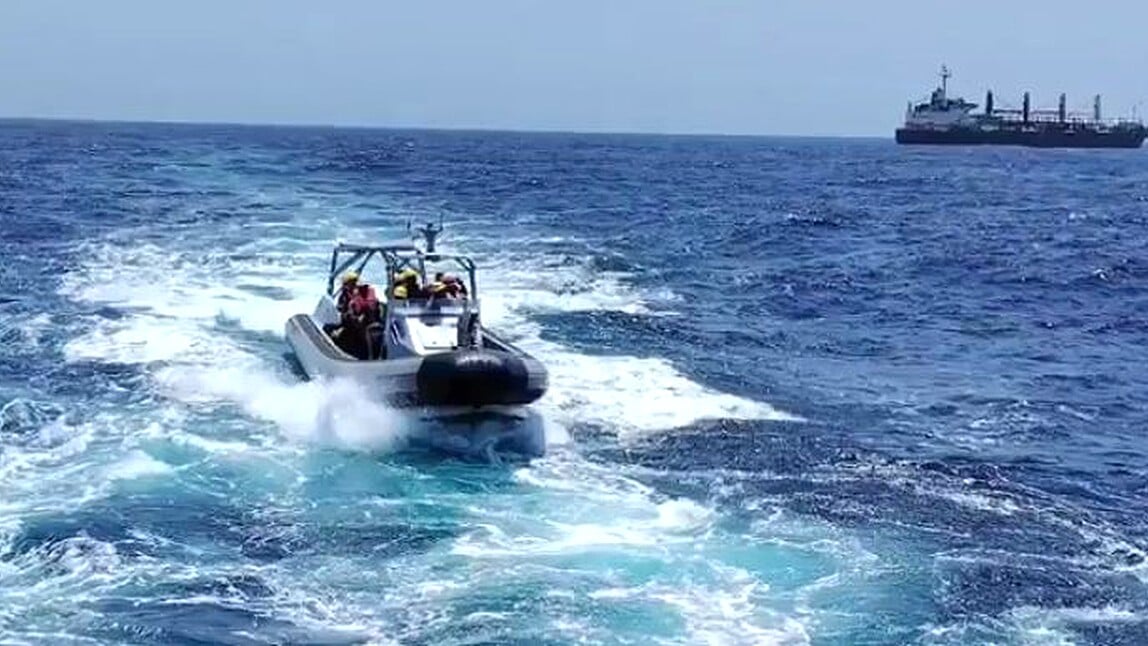




ISLAMABAD: In a swift and daring humanitarian operation that has captured global attention, the Pakistan Navy rescued 18 crew members from a missile-stricken merchant vessel in the Arabian Sea, averting what survivors described as certain death.
The Panama-flagged MV Gold Autumn, carrying cargo from Shanghai to Sohar in Oman, came under repeated missile attacks around 11:30 am on Tuesday, just outside the Strait of Hormuz amid escalating regional tensions following the Iran war that began on February 28.
Explosions rocked the ship, fire spread rapidly, and the final strike punched a hole in the hull while disabling the main engine, forcing the captain to declare the vessel abandoned in rough seas.
Of the 24-member multinational crew, 11 were Chinese, six Bangladeshi, three Indonesian, one Myanmar national and one Vietnamese, according to detailed accounts verified through regional maritime sources.
Four crew members, including one Bangladeshi engine cadet and three Indonesians, managed to board a lifeboat that drifted helplessly for seven hours with a disabled engine, flooding waves and no immediate rescue in sight.
The remaining 18 sheltered on the vessel’s rear deck as flames consumed large buses listed as cargo, reducing them to ashes while the crew fired flares in desperation.
A nearby vessel, MV Uniaich, spotted the lifeboat around 8:30 pm, allowing the four to board and contact their owners via satellite phone, who immediately sought assistance through the Pakistani embassy.
Pakistan Navy responded promptly at 1:00 am, dispatching PNS Hunain, which arrived on scene by 8:00 am on Wednesday and successfully evacuated the 14 crew still aboard the damaged Gold Autumn.
PNS Hunain then picked up the four from MV Uniaich, completing the rescue of all 18 before steaming toward Karachi, where the group reached port safely at around 2:00 pm on Thursday.
Bangladeshi sailor Ehsan Sabri Rihad, an engine cadet from Cox’s Bazar who joined the ship just 10 months ago, recounted the terror in vivid detail to regional media.
“I had just finished lunch when a loud explosion shook the ship,” Rihad said, describing how he rushed to the deck only to witness flames blazing beneath the crane from the first missile strike.
“Another missile hit just behind us moments later,” he added, noting the crew survived by seconds as panic spread and repeated explosions echoed across the vessel.
Rihad and his companions in the lifeboat endured seven hours of drifting, vomiting from rough seas and reciting prayers, convinced they were awaiting death until flares finally drew help.
The operation underscores Pakistan Navy’s growing role in extended-range maritime rescues, having conducted similar swift interventions at distances up to 800 nautical miles in recent years, including medical evacuations from Indonesian-flagged vessels.
Regional media reports, including exhaustive coverage by Bangladesh’s Prothomalo, have authenticated the timeline and crew testimonies, noting no immediate international wire service confirmation as the incident unfolded rapidly.
Pakistan Navy officials confirmed the distress call response and safe transfer of all crew without injury, highlighting the precision of PNS Hunain’s deployment in high-risk waters.
The rescue comes at a time when the Arabian Sea has seen heightened threats from missile activity linked to broader Middle East conflicts, with merchant shipping increasingly vulnerable beyond traditional piracy zones.
Survivors, including the five Bangladeshis named as Ehsan Sabri Rihad, Tawhidur Rahman, Abdullah Al Maruf, Saikat Pal and Riad Hossain, expressed profound gratitude upon reaching Karachi, with Bangladesh Merchant Marine Officers’ Association confirming all are safe and arrangements underway for repatriation.
This latest feat adds to Pakistan Navy’s impressive record of humanitarian missions, which have saved hundreds of lives in the Indian Ocean region through coordinated responses with international maritime rescue centres.
Maritime experts note that such operations not only save lives but also reinforce Pakistan’s commitment to freedom of navigation and regional stability in one of the world’s busiest shipping lanes.
The MV Gold Autumn incident, with its 24 crew facing missile fire and abandonment, serves as a stark reminder of the perils facing multinational seafarers amid geopolitical flashpoints.
Pakistan Navy’s rapid intervention within hours prevented a potential tragedy, showcasing advanced search-and-rescue capabilities honed over years of patrolling volatile waters.
As the rescued sailors recover in Karachi, the event has drawn praise from affected nations, with families and shipping companies lauding the navy’s professionalism and speed.
This successful evacuation of 18 lives from a burning, holed vessel in rough Arabian Sea conditions marks yet another milestone in Pakistan’s maritime humanitarian leadership.