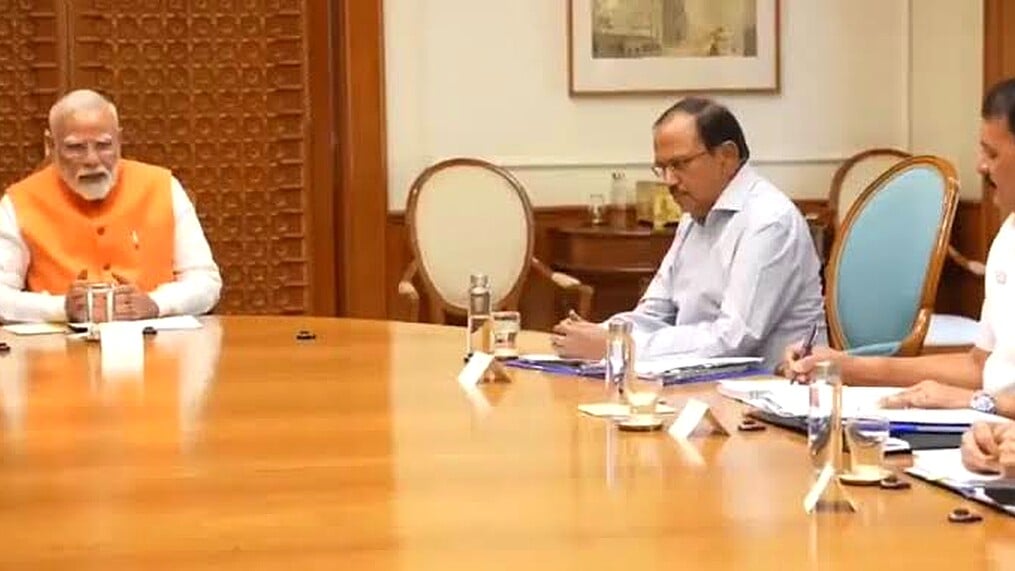




ISLAMABAD: Senior Indian journalist Neelu Vyas has launched a scathing attack on Prime Minister Narendra Modi accusing his government of actively working to undermine high-stakes Iran-US ceasefire talks currently underway in Islamabad.
Vyas claimed that Modi and National Security Adviser Ajit Doval have dispatched senior ministers to the United Arab Emirates and Qatar with the explicit aim of sabotaging the negotiations that Pakistan is mediating.
Pakistani sources in the Middle East have confirmed these frantic Indian diplomatic maneuvers as the world watches Islamabad host delegations from Tehran and Washington for what could become a landmark permanent peace agreement in the Middle East.
The talks which began on Friday April 10 2026 follow a fragile two-week ceasefire announced by US President Donald Trump after intense military exchanges between Iran and US-Israeli forces.
Pakistan successfully facilitated initial de-escalation bringing both sides to the table in Islamabad a feat that New Delhi failed to achieve despite its extensive ties in the Gulf and with Israel.
Analysts note that India which has deep strategic partnerships with Israel and strong economic links with Gulf states watched nervously as Pakistan emerged as the unexpected diplomatic bridge.
Indian External Affairs Minister S Jaishankar was rushed to the UAE while Petroleum Minister Hardeep Singh Puri headed to Qatar raising questions about the real agenda behind these sudden visits.
Sources indicate the Indian team is lobbying Gulf capitals to exert pressure on both Washington and Tehran citing concerns over energy security the Strait of Hormuz and safety of Indian expatriates numbering over nine million in the region.
Yet regional observers see these moves as desperate attempts to reclaim relevance after Pakistan stole the diplomatic spotlight.
Israeli Ambassador to India Reuven Azar added fuel to the controversy by publicly expressing deep distrust in Pakistan calling it a country that sponsors terrorism and stating that Israel relies solely on its American allies rather than Islamabad as a facilitator.
The ambassador's remarks came just hours before the Islamabad talks intensified raising suspicions of coordinated efforts to discredit Pakistan's mediation role.
Neelu Vyas who has previously critiqued aspects of Modi's foreign policy did not mince words saying what Islamabad is achieving today Delhi could not manage despite years of outreach.
She pointed out that India has been left perturbed and isolated as global attention shifts to Pakistan's capital.
Pakistani diplomatic circles confirmed that Indian envoys in Gulf states are spreading narratives aimed at stalling progress on key issues including lifting of sanctions control over the Strait of Hormuz and long-term security guarantees.
The Strait of Hormuz through which nearly 20 percent of global oil passes remains a flashpoint with any disruption potentially spiking oil prices beyond 150 dollars per barrel.
India which imports over 80 percent of its crude oil faces massive economic risks yet its apparent focus remains on undermining rather than supporting the peace process.
Pakistan has waived visa requirements for all delegates and international journalists attending the talks signaling complete transparency and confidence in its neutral role.
Security in Islamabad has been tightened to unprecedented levels with Pakistan Air Force maintaining vigilant patrols to ensure the safety of foreign dignitaries.
The talks are based on Iran's 10-point proposal that demands comprehensive sanctions relief and respect for its regional security interests.
Sources close to the negotiations report steady progress despite external pressures with both US and Iranian sides acknowledging Pakistan's balanced approach.
This diplomatic success stands in stark contrast to India's repeated failures in playing any meaningful role in recent Middle East crises.
Indian media has shown visible hesitation and disappointment at Pakistan's rising profile as a peacemaker.
Regional experts highlight that Pakistan leveraged its unique relations with Iran Saudi Arabia China and the United States to create back channels that New Delhi simply lacked.
The involvement of high-level figures including potential visits linked to the Trump administration underscores the gravity of the moment.
Modi's government which boasts of strong Gulf ties now finds itself accused of prioritizing geopolitical rivalry over regional stability.
As sessions continue in Islamabad the world is witnessing a rare moment where Pakistan has positioned itself at the center of global diplomacy leaving traditional powers scrambling.
The coming hours could determine whether a lasting ceasefire takes shape or if external conspiracies succeed in derailing the process.
Pakistan remains committed to inclusive dialogue insisting that sustainable peace in the Middle East serves the interest of all nations including India.
Yet the reported Indian actions in UAE and Qatar have cast a shadow highlighting how bilateral tensions continue to influence broader regional dynamics.
Senior analysts warn that any successful sabotage could lead to renewed escalation with catastrophic consequences for global energy markets and millions of lives.
For now Islamabad stands firm as the venue where history is being written a reality that has clearly unsettled decision makers in New Delhi.