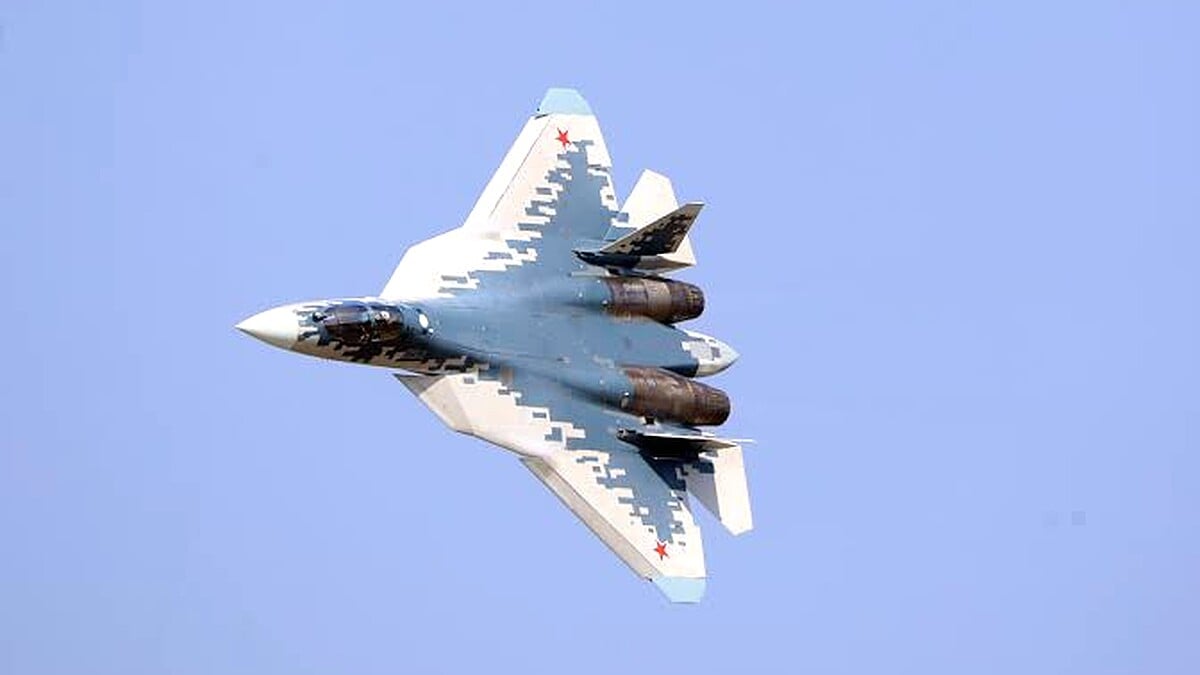




ISLAMABAD: India is racing to close a dangerous fifth-generation fighter gap as the Pakistan Air Force prepares to receive up to 40 Chinese J-35 stealth jets, with New Delhi now in advanced technical negotiations for the acquisition of 36 to 40 Russian Su-57 aircraft.
The proposed deal, positioned explicitly as a bridge capability before the delayed indigenous Advanced Medium Combat Aircraft enters service, could see initial deliveries begin in 2027-28 and the full fleet completed by 2030-31.
Russia has assured production capacity of 16 to 20 Su-57 jets per year by 2027, enabling it to fulfil both domestic needs and export commitments including the potential Indian order.
Current Su-57 airframes operate with AL-41F1 engines that deliver proven thrust-to-weight performance, yet the package includes a firm commitment to upgrade later batches with the next-generation Izdeliye 30 powerplant after 2030.
Pakistan’s J-35 acquisition, formally offered by China and confirmed in the Pentagon’s 2025 China Military Power Report, forms part of a broader package that also includes KJ-500 airborne early warning aircraft and HQ-19 ballistic missile defence systems.
The offer surfaced publicly in June 2025 through official Pakistani channels and has since been fast-tracked, with some projections indicating possible first deliveries to the PAF as early as mid-2026.
This development creates an immediate stealth asymmetry that senior Indian defence planners view as unacceptable, prompting the urgent evaluation of the Russian proposal presented at Wings India 2026 and reinforced during subsequent bilateral talks.
India’s own fifth-generation programme, the AMCA, remains years from operational status with prototype rollout targeted for late 2026 or early 2027, first flight expected in 2028, and full induction projected only by 2035.
The Indian Air Force currently operates a mix of 4.5-generation platforms, including over 260 Su-30MKI fighters and more than 30 Rafale jets, yet lacks any true stealth capability until either the Su-57 or AMCA arrives in squadron strength.
Russian negotiators have sweetened the offer with full technology transfer, local production rights at Hindustan Aeronautics Limited facilities, and a twin-seat command variant optimised for drone-swarm control and network-centric operations.
The base unit price under discussion has been cited in some reports as low as 45 million dollars, making the package financially competitive against Western alternatives while preserving India’s long-standing strategic partnership with Moscow.
Technical negotiations have already entered the deep evaluation phase, focusing on integration of Indian weapons, sensors, and avionics to maximise indigenous content from the outset.
Analysts tracking regional airpower trends note that the Su-57 purchase would allow the Indian Air Force to field a credible fifth-generation deterrent well before the AMCA reaches initial operational capability, thereby neutralising the PAF’s anticipated stealth advantage.
Pakistan’s move follows its successful induction of earlier Chinese platforms such as the JF-17 Block III and J-10CE, demonstrating Beijing’s willingness to accelerate advanced systems transfer to its closest ally.
International coverage in outlets such as Defence News and Jane’s has corroborated the seriousness of both the Indian Su-57 talks and the Pakistani J-35 offer, lending weight to regional media assessments that the South Asian airpower race has entered a decisive new phase.
Should the deal materialise, India would become the first export customer for the Su-57, replicating the landmark success of the Su-30MKI co-production programme that still forms the backbone of its fighter fleet.
Defence officials in New Delhi remain tight-lipped on timelines but insiders confirm that investment quotations from Russia have been received and are under active review by the Indian Air Force and Hindustan Aeronautics Limited.
The strategic calculus is clear: without an interim stealth platform, India risks a capability window in which the PAF could operate unchallenged fifth-generation assets across the western frontier.
Moscow’s production ramp-up pledge and engine upgrade roadmap provide the necessary reassurance that the Su-57 fleet would evolve into a mature, combat-ready force by the early 2030s.
This proposed acquisition therefore represents far more than a simple purchase; it is a calculated interim measure designed to maintain deterrence parity until India’s home-grown AMCA programme matures fully.
Regional security watchers warn that the parallel induction of advanced stealth fleets on both sides of the border will reshape aerial doctrines, escalation dynamics, and future conflict scenarios across South Asia.