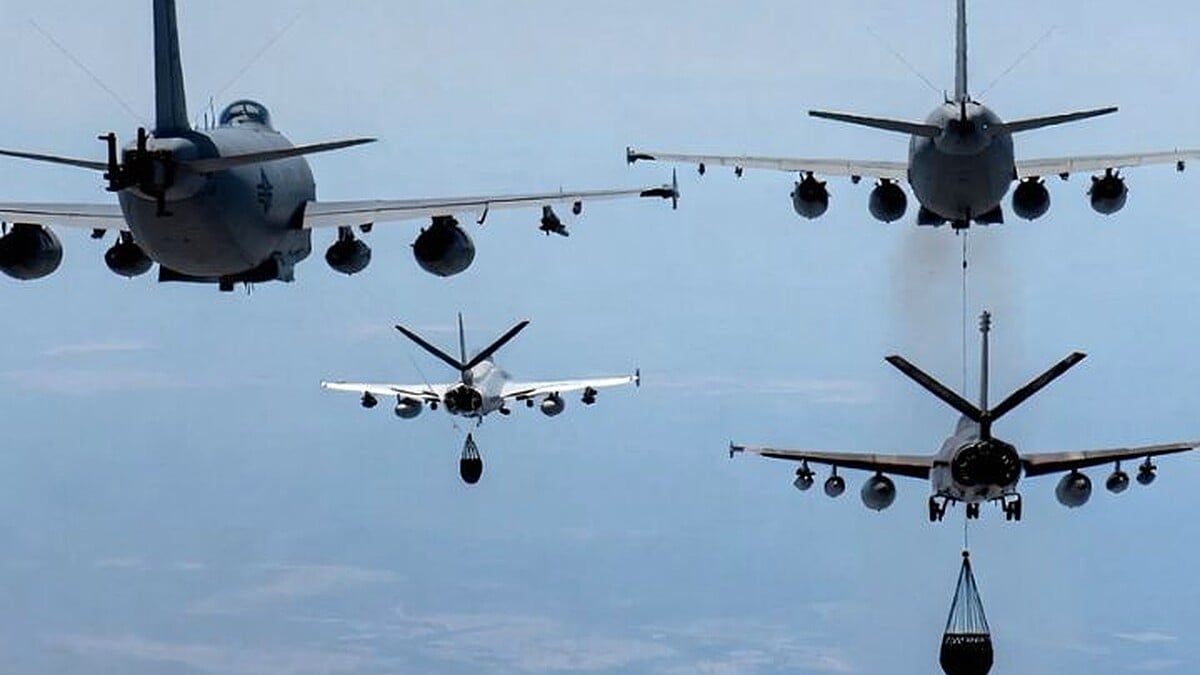
ISLAMABAD: The United States has relocated its KC-135 aerial refueling tankers from Prince Sultan Air Base in Saudi Arabia following intense Iranian ballistic missile and drone attacks on the facility, a tactical adjustment to sustain operations against Iran while addressing heightened risks to forward-deployed assets.
The move, reported on March 9, 2026, comes amid the ongoing US-Israeli campaign against Iran that began on February 28.
Prince Sultan Air Base, located southeast of Riyadh in Al-Kharj, hosted a major US buildup in late February.
Satellite imagery revealed up to 22 KC-135 Stratotankers, alongside F-16 fighters, C-130 transports, and E-3 AWACS aircraft.
These tankers provided essential mid-air refueling for extended bombing sorties over Iranian territory.
Iran launched retaliatory strikes across Gulf states hosting US forces, targeting Prince Sultan repeatedly since early March.
Saudi Arabia’s Ministry of Defense intercepted multiple ballistic missiles and drones aimed at the base, including two on March 7 and additional attempts in following days.
Some projectiles fell in uninhabited areas after successful interceptions, while explosions near the facility triggered regional alerts.
Footage circulated showing impacts close to US positions, though no major structural damage was officially confirmed at the base.
The attacks highlighted limitations in layered air-defense systems protecting concentrated logistics hubs.
Defence Security Asia described the tanker dispersal as a response to these threats, noting risks to high-value aircraft despite ongoing Saudi-US interception efforts.
Relocated tankers have been tracked heading toward European bases, dispersing assets to maintain refueling capability from safer locations.
This mirrors earlier evacuations from Al Udeid Air Base in Qatar before hostilities intensified.
US officials portray the repositioning as measured force protection rather than retreat.
The base continues to support other operations, with no indication of complete withdrawal.
A seventh US service member died from injuries sustained in an Iranian attack on Saudi Arabia on March 1.
CENTCOM identified the casualty as Sgt. Benjamin N. Pennington, wounded at Prince Sultan.
Iran’s barrages have targeted multiple sites, including US facilities in Kuwait, Bahrain, and the UAE.
Saudi defenses destroyed drones near oil fields and intercepted threats over Riyadh.
The relocation sustains aerial campaigns requiring tanker support for long-range missions.
Dispersal reduces vulnerability to breakthrough strikes amid interceptor shortages noted in open-source analyses.
Operations against Iran persist, with CENTCOM reporting over 3,000 targets struck since the campaign’s start.
The conflict has entered its second week, with both sides trading extended strikes.
Iran claims reduced missile and drone efficacy due to suppressed air defenses.
US and Israeli forces maintain air dominance, enabling deeper penetrations.
Gulf states face collateral impacts, with economic ripples from disrupted shipping and heightened alerts.
Saudi Arabia coordinates closely with US partners to defend territory.
The tanker move underscores challenges of basing in contested zones.
Observers view it as pragmatic amid evolving threats.
Prolonged engagement could prompt further posture adjustments.
Energy security remains tied to regional stability.
The US emphasizes resilience through dispersed operations.
As strikes continue, asset protection shapes campaign sustainability.
This development reflects the fluid dynamics of the conflict.