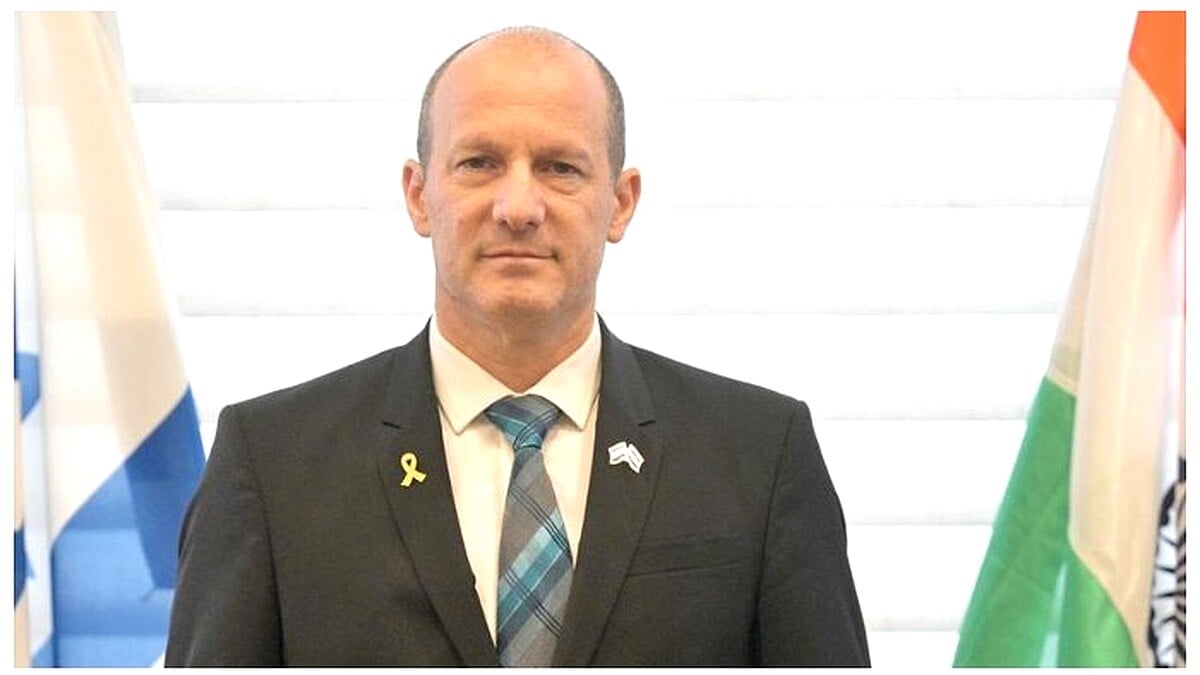




Israeli envoy questions Islamabad's reliability despite its key role in brokering fragile truce.
ISLAMABAD: Israeli Ambassador to India Reuven Azar has bluntly stated that Israel does not view Pakistan as a credible player in regional diplomacy.
The remark came amid Pakistan's high-profile mediation that helped secure a two-week ceasefire between the United States and Iran following weeks of escalating tensions and strikes.
Azar made the comments while speaking to ANI in New Delhi on Thursday, casting doubt on Islamabad's facilitation efforts even as international reports highlight Pakistan's central involvement.
He noted that the United States decided to use Pakistan's services for its own strategic reasons, drawing parallels with past American engagement of Qatar and Turkey to reach agreements with Hamas.
“For us, it is very important to stay in sync with the United States when it comes to the substance and the essence of the outcome we want to see,” Azar added.
Pakistan's mediation marked a significant diplomatic flex for the nuclear-armed nation, which leveraged its ties with both Washington and Tehran.
Prime Minister Shehbaz Sharif announced the ceasefire on social media, stating that the two sides agreed to an immediate halt in hostilities, including in Lebanon where Israeli strikes had occurred.
Analysts point out that Pakistan facilitated backchannel talks without direct contact between the adversaries, a feat not seen in previous Iran nuclear negotiations or the Abraham Accords.
US President Donald Trump acknowledged receiving a ceasefire proposal via Sharif and agreed to suspend actions subject to Iran opening the Strait of Hormuz fully.
The truce involves complex demands, including Iran's removal of highly enriched uranium stocks, halting enrichment, curbing ballistic missiles, and cutting funding to regional allies.
Pakistan's role emerged after months of shuttle diplomacy, with military chief Asim Munir and Sharif engaging senior US officials including Trump, JD Vance, and Marco Rubio in Washington.
Regional experts estimate that Pakistan's efforts prevented a wider conflict that could have disrupted global energy supplies through the Strait of Hormuz, which handles nearly 20 percent of global oil trade.
Despite the breakthrough, Azar's skepticism underscores deep-seated Israeli reservations rooted in Pakistan's longstanding support for the Palestinian cause and absence of diplomatic ties with Tel Aviv.
Pakistan has no formal relations with Israel, primarily due to the unresolved Palestinian statehood issue.
International media including NDTV, WION, Indian Express, and Al Jazeera have extensively covered the mediation, confirming Pakistan's pivotal position while noting Israeli and some Western doubts.
Pakistani officials, including Foreign Minister Ishaq Dar, had earlier accused Israel of attempting to undermine the talks through strikes at a critical juncture.
The ceasefire remains fragile, with follow-up talks scheduled in Islamabad as early as April 10.
Pakistan's success stems from its unique positioning, maintaining working relations with the US, Iran, Saudi Arabia, and China simultaneously.
This balancing act allowed Islamabad to act as a trusted messenger when direct communication broke down amid military escalation.
US Secretary of State Marco Rubio has separately acknowledged Pakistan's offers, including potential troop contributions to a Gaza stabilisation force, though details remain under discussion.
Such overtures highlight Pakistan's broader ambitions in Middle East peacemaking, despite historical constraints.
Critics within Israel and some Indian circles view Pakistan's involvement as opportunistic, citing its domestic economic challenges and need for international legitimacy.
Yet data from think tanks suggest successful mediation could enhance Pakistan's global standing, potentially unlocking economic aid and investment flows estimated in billions.
The episode revives debates on Pakistan's foreign policy doctrine of engaging all major powers without exclusive alignments.
As the two-week pause holds tenuously, questions linger on whether Israel's stated consistency with US objectives will align with Pakistan-brokered outcomes.
Observers note that while Azar dismissed credibility publicly, the US reliance on Islamabad for facilitation speaks to pragmatic geopolitics over ideological preferences.
Pakistan has positioned itself as an indispensable bridge in a volatile region, a role that could reshape South and West Asian dynamics in the coming months.
Tag: Reuven Azar, US-Iran Ceasefire, Pakistan Mediation, Israel Diplomacy