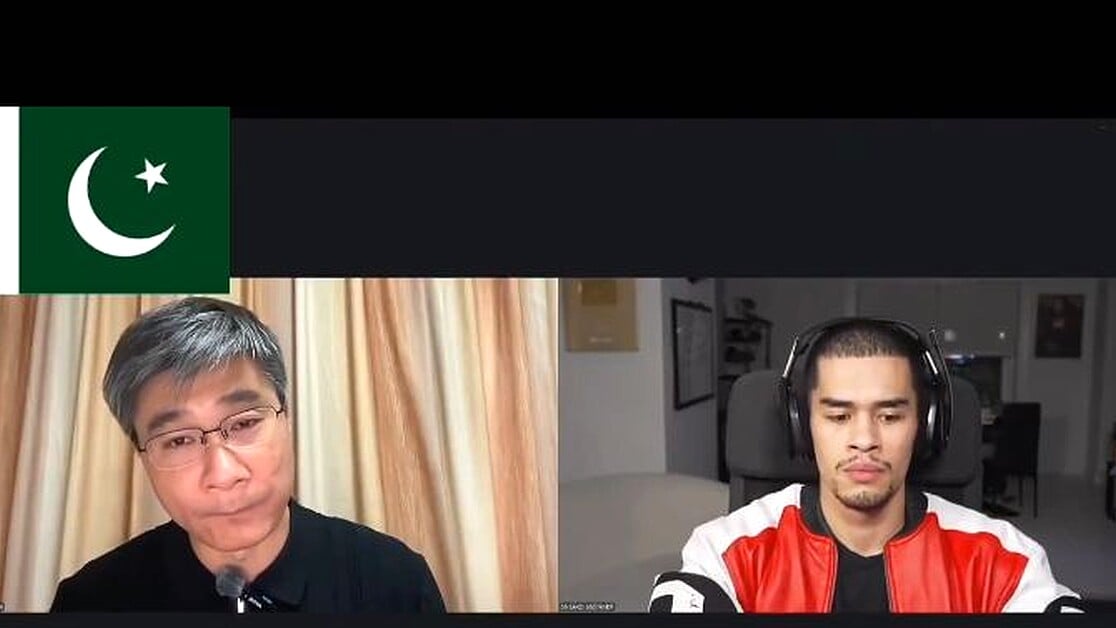
ISLAMABAD: A viral social media clip featuring Chinese-Canadian educator Professor Jiang Xueqin has ignited widespread discussion in Pakistan and beyond, with claims that he predicted a US ground invasion of Iran would originate from Pakistani territory, specifically Balochistan province.
The clip, shared by an account associated with streamer Sneako, shows excerpts from a recent live discussion on Kick.com. In it, Jiang speculates on potential escalation paths in the ongoing US-Iran tensions, which have involved airstrikes, Strait of Hormuz disruptions and regional proxy engagements since early 2026.
Jiang, a Yale graduate and Beijing-based history and philosophy teacher, hosts the YouTube channel Predictive History. He gained prominence in 2024 for three forecasts: Donald Trump’s return to the presidency, a subsequent US war with Iran, and an ultimate American defeat in such a conflict due to logistical overextension and Iran’s defensive advantages.
The specific mention of Pakistan emerged in a hypothetical scenario during the stream. Jiang noted Iran’s southeastern border with Pakistan—near Balochistan—as comparatively more accessible and less fortified than Iran’s heavily defended northwestern or Persian Gulf fronts. He suggested that if external pressures shifted Pakistan’s stance, such as through its mutual defense pact with Saudi Arabia, Pakistani soil could theoretically serve as a staging area for US forces.
This idea ties into Jiang’s broader argument that any ground invasion of Iran would prove catastrophic for the United States. He draws historical parallels to Athens’ failed Sicilian Expedition during the Peloponnesian War, emphasizing rugged terrain, asymmetric warfare, extended supply lines and domestic political costs as insurmountable barriers.
Analysts and commentators have widely described the Pakistan route as highly improbable. Pakistan maintains close economic and border cooperation with Iran, including trade and energy discussions. Approximately 20 percent of Pakistan’s population is Shia, with significant representation in military and political circles, making any aggressive posture against Shia-majority Iran politically explosive domestically.
Pakistan has historically balanced relations among major powers, including strong ties with China through the China-Pakistan Economic Corridor and diplomatic support for Iran in international forums. Past experiences during the US-led War on Terror, which resulted in thousands of military and civilian casualties alongside economic strain, have left little appetite for renewed involvement in foreign-led operations.
Geopolitical experts point out additional obstacles: Balochistan’s challenging terrain, ongoing insurgency issues, and the risk of opening multiple fronts amid existing tensions with India and Afghanistan. Allowing US staging would likely provoke severe internal backlash and undermine Pakistan’s strategic autonomy.
Jiang himself frames the Pakistan hypothesis as speculative within his core thesis—that the US lacks the capacity for a sustained ground campaign against Iran. In lectures and interviews, including on Breaking Points and his own channel, he stresses Iran’s preparations, regional alliances and control over key chokepoints as decisive factors favoring Tehran in a prolonged conflict.
Social media reactions to the clip have been polarized. Many Pakistani users dismissed the notion outright, labeling it unrealistic or strategically suicidal. Others referenced unverified reports of military movements near the border, though no credible evidence links these to invasion preparations.
No official statements from the US, Pakistan or Iranian governments have indicated plans for ground operations through Pakistani territory. Current US strategy appears focused on air and naval dominance, with ground troops described as a high-risk option that could trap forces in unfavorable conditions.
Jiang’s earlier accurate forecasts have lent weight to his analyses among online audiences, earning him nicknames like “China’s Nostradamus.” However, experts caution that geopolitical predictions remain probabilistic, influenced by fluid alliances, intelligence assessments and unforeseen events.
The viral nature of the discussion underscores growing public interest in Middle East developments and their potential ripple effects on South Asia. As tensions persist, observers continue monitoring for signs of further escalation, while emphasizing the need for diplomatic channels to prevent broader conflict.
In summary, Professor Jiang has not issued a definitive prediction of a US invasion from Pakistan’s Balochistan. Instead, he raised it as one hypothetical logistical consideration in explaining why he believes any full-scale ground war would end disastrously for Washington and reshape global power dynamics.