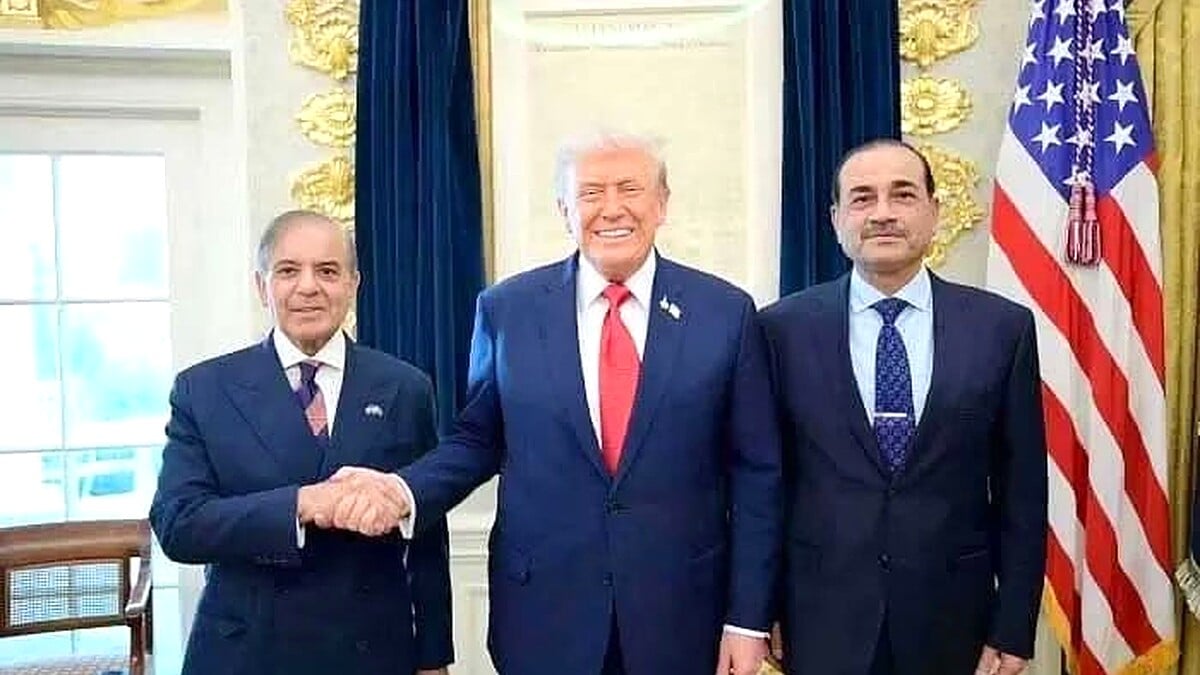




ISLAMABAD: In a stunning diplomatic reversal that has stunned global capitals, Pakistan Army Chief Field Marshal Asim Munir has single-handedly steered the United States and Iran toward a fragile two-week ceasefire, positioning Islamabad as the unlikely epicentre of Middle East de-escalation.
The breakthrough unfolded late on Tuesday when President Donald Trump announced the halt to further strikes on Iran, explicitly crediting Prime Minister Shehbaz Sharif and Field Marshal Munir for their tireless back-channel efforts.
Trump posted on Truth Social that constructive talks with the Pakistani leadership prompted the pause, conditional on Iran reopening the Strait of Hormuz, the chokepoint carrying one-fifth of global oil trade.
Iranian Foreign Minister Abbas Araghchi immediately echoed the gratitude, thanking “my dear brothers PM Sharif and Field Marshal Munir” for their relentless mediation that prevented catastrophe.
Oil markets reacted instantly, with benchmark prices plunging nearly 20 percent from a peak of 112 dollars per barrel to around 92 dollars within hours of the announcement, easing fears of an energy shock that could have added trillions to global inflation.
Field Marshal Munir, elevated last year as only the second officer in Pakistan’s history to hold the rank of Field Marshal and Chief of Defence Forces, spent the entire night coordinating with US Vice President JD Vance, special envoy Steve Witkoff and Araghchi.
Multiple intelligence sources confirm Munir relayed precise amendments to a ten-point Iranian proposal that formed the basis of the so-called Islamabad Accord framework.
Pakistan had offered to host formal negotiations in Islamabad, leveraging its unique diplomatic channels to both Washington and Tehran that no other actor could replicate.
The army chief’s personal rapport with Trump proved decisive, built during the 2025 India-Pakistan crisis when Islamabad openly embraced American mediation and even nominated Trump for the Nobel Peace Prize.
Trump has repeatedly called Munir his “favourite field marshal” and praised him for saving millions of lives through quiet counsel.
This latest intervention comes amid a six-week conflict that began with US-Israeli strikes on Iranian targets in late February, prompting Tehran to close the Strait of Hormuz and spike global energy prices.
European Union Commission President Ursula von der Leyen publicly thanked Pakistan for its mediator role, while Kazakhstan President Kassym-Jomart Tokayev hailed the “full ceasefire and truce” achieved through Sharif and Munir’s efforts.
Analysts note Pakistan’s balancing act was precarious yet masterful, maintaining longstanding ties with Iran while honouring its strategic defence pact with Saudi Arabia signed last year.
By refusing Riyadh’s request to deploy assets against Iran earlier, Islamabad kept open channels to Tehran without alienating Gulf allies.
Economic data underscores the stakes: prolonged closure of the Strait could have disrupted 21 million barrels of daily oil shipments, sending prices beyond 150 dollars and triggering recessions across Asia and Europe.
Field Marshal Munir’s intervention has already stabilised markets and bought critical time for permanent talks, with observers describing the two-week window as a narrow but viable bridge to broader de-escalation.
Pakistani officials emphasise that the army chief operated within a whole-of-government approach, yet his direct access to Trump and Tehran’s Revolutionary Guards gave him unmatched leverage.
Regional media reports from Dawn and Geo TV detail how Munir’s March visit to Saudi Arabia laid groundwork for wider coordination before pivoting to direct US-Iran shuttle diplomacy.
Global financial institutions now project that if the ceasefire holds, crude prices could stabilise below 85 dollars by June, injecting fresh confidence into emerging markets including Pakistan’s own economy.
Critics caution the peace remains fragile, with both sides still viewing the conflict through lenses of victory, yet few dispute Munir’s role as the indispensable catalyst.
As world leaders converge on the implications, one fact stands clear: a Pakistani general has rewritten the script of great-power confrontation, proving quiet military diplomacy can achieve what summits often cannot.
The coming days will test whether the Islamabad Accord evolves into lasting peace or merely delays the next flare-up, but for now Field Marshal Asim Munir stands as the improbable architect of restraint in a combustible region.