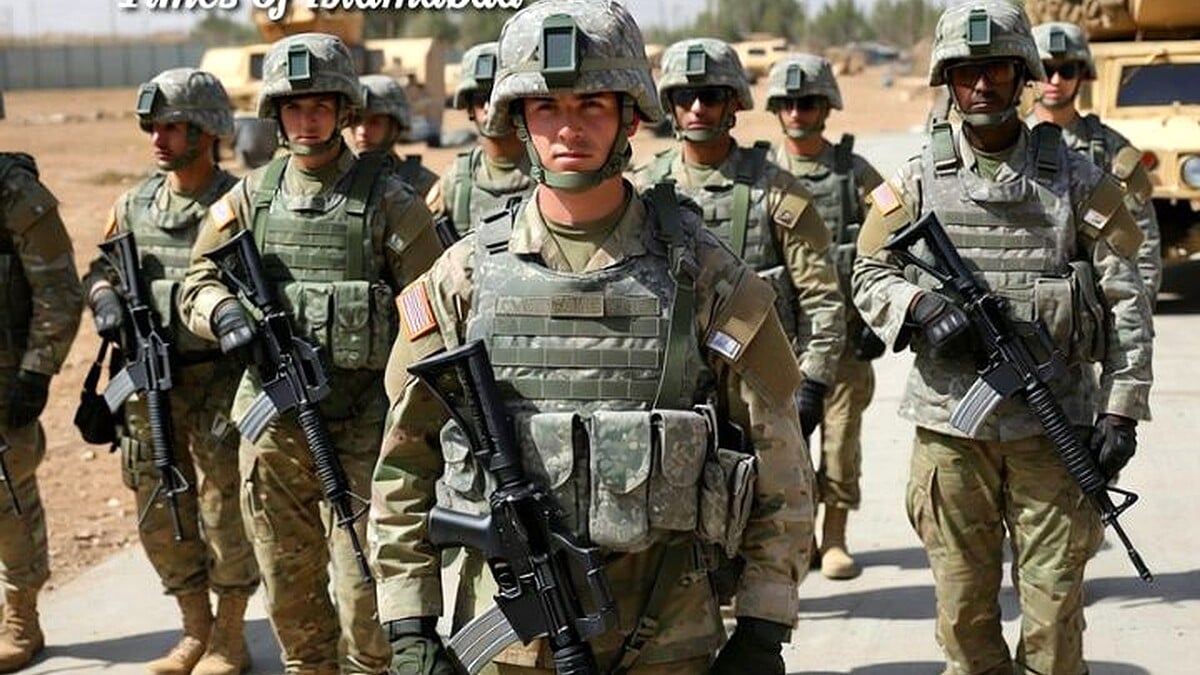
ISLAMABAD: Iran’s Supreme National Security Council Secretary Ali Larijani has claimed that Iranian forces have captured several American soldiers since the outbreak of hostilities with the United States and Israel on February 28, 2026.
The senior Iranian official made the assertion in posts on social media platform X and in statements to state media, suggesting the captures occurred with intelligence assistance from a friendly country.
Larijani accused the US administration under President Donald Trump of concealing the incidents by classifying the captured personnel as killed in action, thereby manipulating public perception of casualties.
He referenced confirmed US losses, including six soldiers killed in an Iranian drone strike on a facility in Kuwait, as part of what he described as a misleading narrative on battlefield outcomes.
No specific number of captured soldiers or precise locations were provided by Larijani, though some reports cited his remarks indicating the events took place in one of the neighboring countries.
The claim emerges against the backdrop of intensified aerial exchanges, with US and Israeli strikes targeting Iranian military infrastructure, nuclear-related sites, and command centers across the country.
Iran has responded with missile and drone barrages aimed at US bases and assets in the Persian Gulf region, including facilities in Kuwait, Bahrain, and Saudi Arabia.
US Central Command swiftly rejected the Iranian allegations, describing them as fabrications intended to deceive.
A CENTCOM spokesperson, US Navy Captain Tim Hawkins, stated that no American service members have been taken hostage or captured by Iranian forces.
The command labeled the assertions as another instance of the Iranian regime’s pattern of disseminating lies and propaganda during the conflict.
Independent verification of the capture claims remains absent, with no evidence such as photographs, videos, or third-party confirmations emerging from neutral sources.
Some circulating images purportedly showing captured US personnel have been debunked as AI-generated fabrications in preliminary assessments.
The timing of Larijani’s statement coincides with reports from US intelligence officials that Russia has been sharing satellite imagery and other data on American military positions with Iran.
These disclosures, cited in multiple Western media outlets, indicate Moscow has provided updated intelligence on US warships, aircraft, and troop locations since the war’s onset.
Such assistance could theoretically enable more precise Iranian targeting, though officials have cautioned that no direct Russian orchestration of strikes has been confirmed.
Russia maintains longstanding ties with Iran, including military cooperation and opposition to Western sanctions, positioning it as a potential source of the “friendly” intelligence referenced indirectly in Iranian narratives.
The conflict, now in its second week, has seen over 3,000 US strikes on Iranian targets, significantly degrading Tehran’s air defense and missile capabilities, according to CENTCOM assessments.
Iranian retaliatory actions have caused confirmed casualties among US personnel and allies, but no ground incursions or prisoner exchanges have been acknowledged by either side.
Analysts view the capture claim as part of a broader information warfare strategy employed by both parties to influence domestic morale and international opinion.
For Tehran, such assertions aim to project resilience and military success despite heavy bombardment.
For Washington, firm denials serve to maintain operational security and counter adversarial propaganda.
The escalation follows the killing of Iran’s Supreme Leader Ali Khamenei in initial US-Israeli strikes, prompting vows of severe retaliation from Iranian authorities.
Gulf allies have expressed concerns over the conflict’s regional spillover, including disruptions to energy infrastructure and maritime traffic.
As hostilities continue, the absence of concrete proof surrounding the prisoner claims underscores the challenges of discerning fact from fiction in active wartime environments.
Military observers note that any verified captures would represent a major propaganda victory for Iran and a significant escalation, potentially complicating diplomatic off-ramps.
Until substantiated evidence surfaces, the allegation stands as an unconfirmed assertion amid a rapidly evolving theater of operations.
The situation remains fluid, with both sides trading strikes and narratives in what has become a multifaceted confrontation involving air power, proxies, and information operations.
US forces maintain a posture of overwhelming superiority in conventional capabilities, while Iran leverages asymmetric tools and alliances to sustain resistance.
The coming days may clarify whether these claims hold any merit or fade as part of the fog of war.