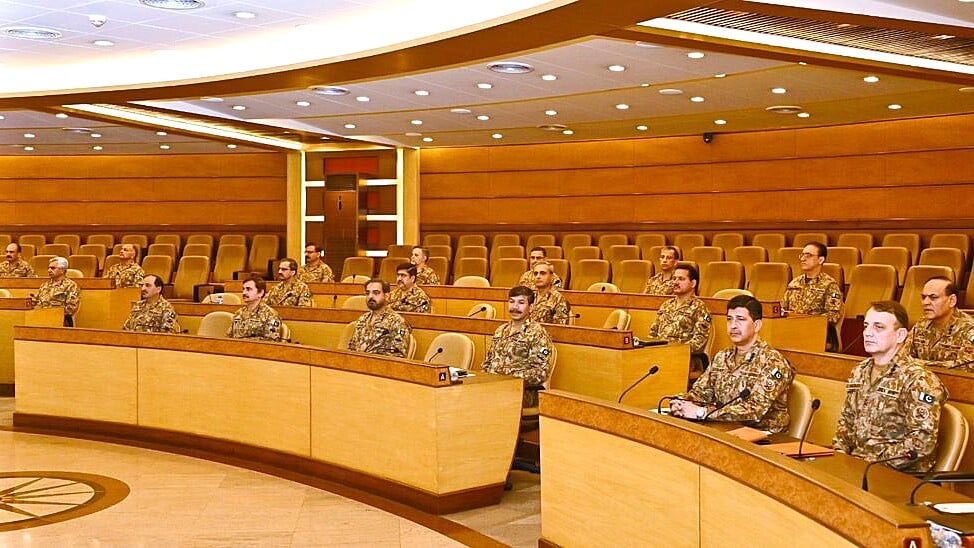




ISLAMABAD: The 274th Corps Commanders Conference chaired by Chief of Defence Forces and Chief of Army Staff Field Marshal Asim Munir has unequivocally condemned Iranian attacks on Saudi Arabia’s petrochemical, industrial and water structures, terming them a serious setback to regional peace efforts.
Senior military leadership described the strikes as unacceptable escalation that threatens stability in the Gulf and beyond.
The high-level forum held in Rawalpindi reviewed the rapidly deteriorating security situation in the Middle East where Iranian drone and missile barrages have repeatedly targeted key Saudi facilities.
Recent overnight attacks hit the sprawling Jubail industrial complex, home to SABIC petrochemical plants, causing loud explosions and fires that forced precautionary shutdowns of production units.
Regional media reports, including those from Saudi sources and Fars News Agency, confirmed damage to industrial sites linked to major energy corporations, with debris from intercepted projectiles sparking blazes in critical infrastructure zones.
Pakistan’s defence establishment views these actions as direct challenges to longstanding strategic ties.
Pakistan and Saudi Arabia signed a Strategic Mutual Defence Agreement last year under which an attack on one is considered an attack on both.
The Corps Commanders Conference stressed that such violations undermine years of diplomatic efforts aimed at de-escalation.
Field Marshal Asim Munir earlier held detailed discussions with Saudi Defence Minister Prince Khalid bin Salman in Riyadh on March 7, focusing on the gravity of Iranian drone and missile strikes and joint measures to halt them.
That meeting highlighted the need for coordinated responses within the framework of the bilateral defence pact.
Military sources indicated that the latest conference reinforced Pakistan’s firm stance in support of Saudi territorial integrity and energy security.
Saudi Arabia, the world’s top oil exporter, relies heavily on facilities like Jubail and Ras Tanura for global petrochemical supply chains.
Attacks have already led to temporary closures and heightened alerts across Gulf refineries, raising fears of supply disruptions.
Open-source reports from March and early April documented multiple Iranian strikes on energy assets in Saudi Arabia, UAE, Kuwait and Bahrain, with some incidents causing fires at refining and storage sites.
Iran’s Revolutionary Guards claimed responsibility for targeting petrochemical plants in the region, escalating tensions amid broader conflict involving US and Israeli actions.
Pakistan’s military leadership has consistently advocated for restraint and dialogue.
The country has hosted ministerial meetings with Saudi Arabia, Turkey and Egypt to push diplomatic solutions and prevent wider conflagration.
Despite official neutrality in the larger conflict, Islamabad’s strategic partnership with Riyadh remains a cornerstone of its Gulf policy.
The timing of the Corps Commanders statement is particularly significant as US President Donald Trump’s deadline to Iran expires within hours.
Trump has issued stern warnings, stating that failure to reach a deal could result in severe consequences, including strikes on Iranian infrastructure such as power plants and bridges.
He recently posted that an entire civilisation could be destroyed if demands regarding the Strait of Hormuz are not met.
The strategic waterway remains a flashpoint, with closure threats impacting 20 percent of global oil trade.
Analysts note that any further Iranian strikes on Saudi water desalination plants could prove catastrophic.
Gulf states depend on desalination for up to 90 percent of their drinking water supply in one of the driest regions on earth.
Damage to such facilities would trigger humanitarian crises far beyond military targets.
Pakistan’s armed forces maintain close operational coordination with Saudi counterparts through joint exercises and training programmes.
Thousands of Pakistani troops have historically served in Saudi security roles, underscoring deep military-to-military bonds.
The conference also reviewed internal security and border management but devoted substantial time to the external threat emanating from the Gulf crisis.
Senior commanders expressed concern that unchecked escalation could spill over, affecting shipping lanes and energy prices worldwide.
Global oil markets have already shown volatility, with analysts warning of potential spikes if Jubail-type facilities suffer sustained damage.
Pakistan, as a major importer of crude and refined products, stands vulnerable to any disruption in Gulf supplies.
The military forum called upon all regional actors to exercise maximum restraint and return to the negotiating table.
It reiterated Pakistan’s commitment to peace while standing firmly with its strategic allies against aggression.
Field Marshal Asim Munir’s leadership has emphasised proactive diplomacy backed by credible deterrence.
The Corps Commanders Conference concluded with a unified message that deliberate targeting of civilian-linked industrial and water infrastructure crosses red lines and invites strong condemnation.
As Trump’s deadline ticks down, the region braces for possible further developments.
Pakistan’s clear position sends a calibrated signal of support to Riyadh without direct involvement in hostilities.
Observers see the statement as a careful balancing act reflecting Islamabad’s strategic interests in both Gulf stability and broader Muslim world unity.
The 274th conference thus underscores Pakistan’s role as a responsible stakeholder urging de-escalation while safeguarding vital alliances.