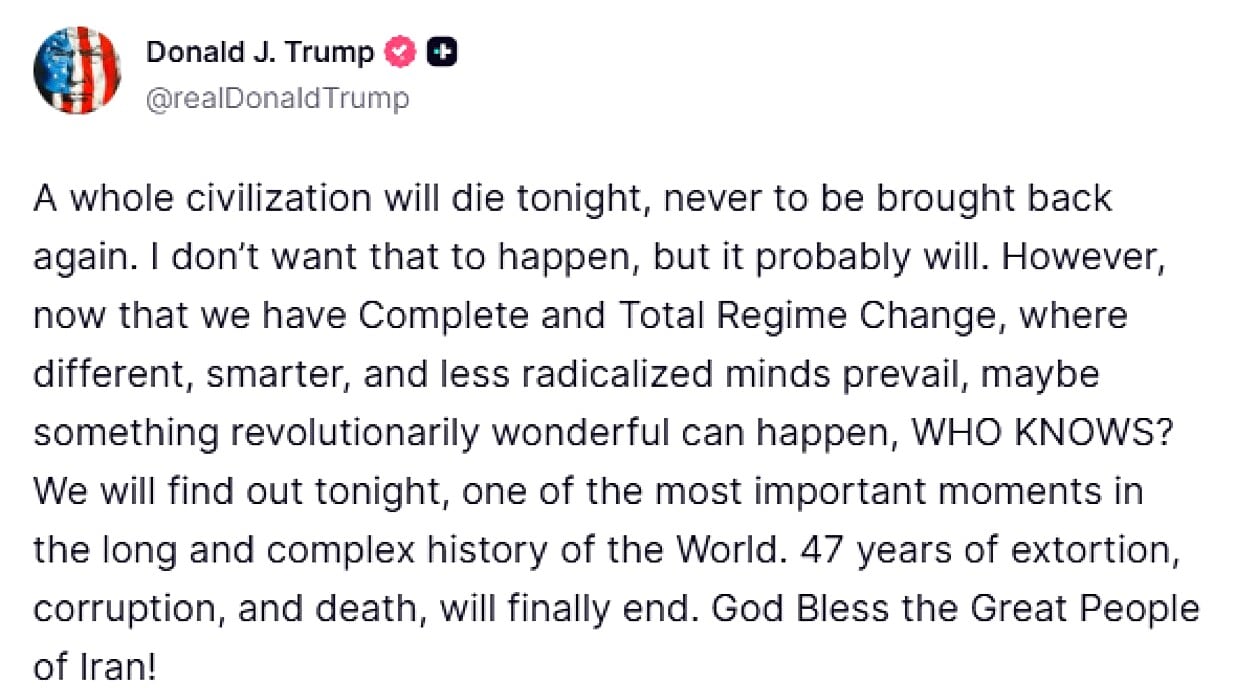




ISLAMABAD: US President Donald Trump has issued a chilling warning that a whole civilization could perish tonight if Iran fails to meet a critical deadline, marking one of the most dramatic moments in modern Middle East history.
In a stark social media statement issued late Tuesday, Trump declared that a complete civilization would die tonight and never return, adding he did not want this outcome but it might happen anyway.
Trump referenced 47 years of blackmail, corruption and death under the previous Iranian regime, stating these would finally end. He expressed hope for a revolutionary and wonderful new chapter with less extremist and more intelligent leadership now in place after reported regime shifts.
The US president framed the night ahead as potentially one of the most important moments in the world’s long and complex history. He concluded with a prayer that God bless the great people of Iran.
Analysts monitoring the rapidly evolving situation believe Trump’s tone and message do not rule out the option of a tactical nuclear strike, a possibility previously hinted at by some hardliner Israeli officials in earlier phases of the conflict.
The warning comes as a US-imposed deadline looms for Iran to reopen the Strait of Hormuz, a chokepoint carrying nearly 21 percent of global oil trade, equivalent to about 21 million barrels per day according to recent energy data.
International media including BBC, The Guardian, The New York Times and CBS have extensively covered Trump’s statement, confirming the gravity of the ultimatum tied to ongoing US-Israeli military operations against Iranian targets.
Regional Pakistani media outlets such as HUM News reported the Urdu translation of Trump’s exact words, highlighting fears of total regime transformation already underway in Tehran.
US strikes under Operation Epic Fury have already devastated Iranian naval capabilities and air force infrastructure, with multiple command centres destroyed and key leaders from the old regime reported eliminated.
Intelligence assessments suggest Iran’s air defences are in ruins, while its navy has effectively ceased to function as a coherent force in the Persian Gulf.
Oil market analysts warn that any prolonged closure of the Strait of Hormuz could send global crude prices surging beyond 150 dollars per barrel, triggering immediate inflation shocks in energy-importing nations including Pakistan, India and Europe.
Pakistan’s Corps Commanders Conference has already condemned related regional attacks, underscoring Islamabad’s concern over spillover effects near its western borders.
Experts tracking nuclear proliferation note that Iran’s uranium enrichment has reached near-weapons-grade levels in the past, though current regime change dynamics may have altered command structures overseeing those facilities.
Trump has repeatedly emphasised that regime change was never the stated goal, yet acknowledged that deaths of original hardline leaders have resulted in a less radical and more reasonable negotiating group emerging.
Despite this, the president maintained maximum pressure, threatening to bomb Iranian power plants, bridges and other infrastructure if demands remain unmet by the 8pm ET deadline.
Israeli officials have in prior briefings hinted at extreme options including low-yield tactical nuclear use if existential threats from Iranian missile programmes persist, though Trump has publicly downplayed such possibilities in some remarks.
Global stock markets reacted sharply to the statement, with oil futures jumping over 8 percent in after-hours trading while defence stocks gained significantly.
The United Nations Security Council remains divided, with emergency sessions called but no immediate resolution in sight amid veto threats from permanent members.
Diplomatic sources indicate backchannel talks continue even as military preparations intensify on both sides.
Iranian state media has dismissed some US claims while calling on citizens to form human shields around strategic sites including power plants.
The coming hours could determine whether the conflict de-escalates into a new political era in Tehran or descends into unprecedented destruction across the region.
Regional observers in South Asia fear massive refugee flows and economic disruption if full-scale infrastructure targeting occurs.
Energy security experts highlight that Saudi Arabia and other Gulf states have already heightened alerts, with potential production increases discussed to offset any Hormuz disruption.
Trump’s message blends threat with a cautious opening for a smarter future leadership, leaving the world watching anxiously as the deadline approaches.