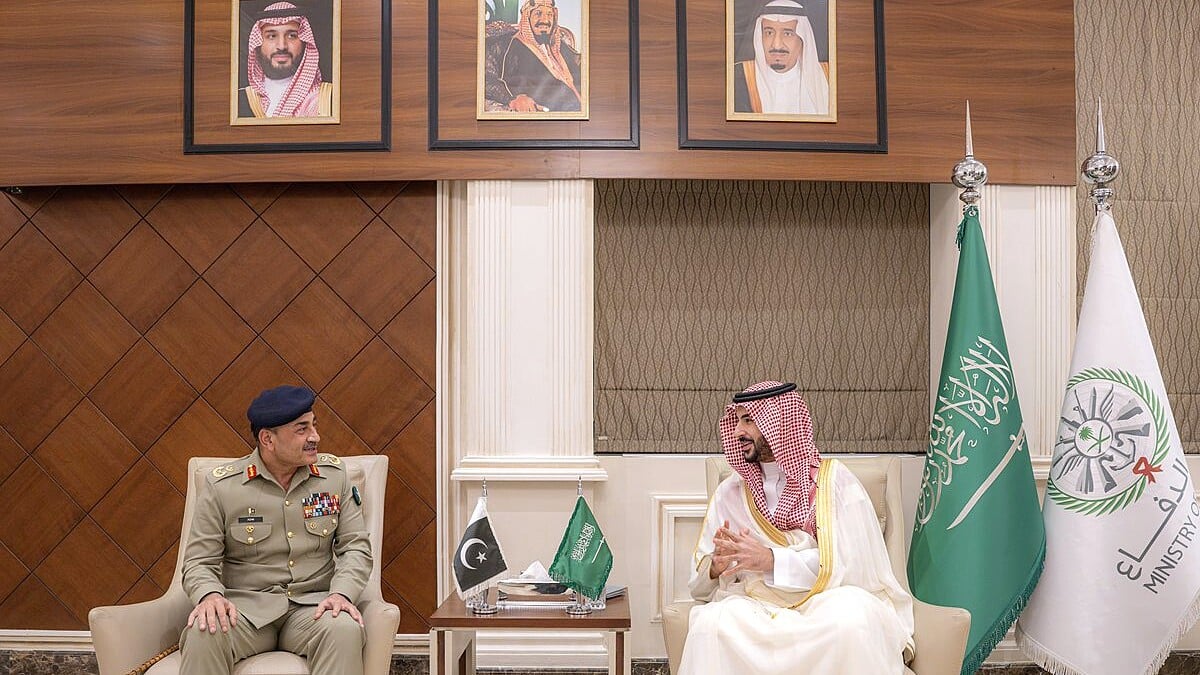
ISLAMABAD: Chief of Defence Forces and Chief of the Army Staff Field Marshal Syed Asim Munir held discussions with Saudi Defence Minister Prince Khalid bin Salman on the security implications of recent Iranian drone and missile strikes targeting the Kingdom.
The Inter-Services Public Relations issued a statement describing the meeting as focused on the gravity of the situation stemming from these attacks.
The Pakistani formulation acknowledged the attacks and the necessity for measures to halt them under the Strategic Mutual Defence Agreement signed between the two nations in September 2025.
This agreement establishes a framework of collective defence, treating aggression against one as aggression against both, thereby strengthening joint deterrence.
The statement expressed Pakistan’s solidarity with Saudi Arabia at a moment when its territory faces direct military pressure from Iranian projectiles.
Saudi air defences have intercepted multiple ballistic missiles aimed at Prince Sultan Air Base near Riyadh, a facility hosting United States forces, as well as drones directed towards oil infrastructure such as the Shaybah field.
Reports indicate that Iranian strikes have extended to other Gulf states, including Qatar, Bahrain, and the United Arab Emirates, amid the broader US-Israel conflict with Iran.
In contrast to the Saudi side’s direct reference to Iranian attacks and the imperative to stop them, the Pakistani statement swiftly pivoted to calls for restraint and prudence.
It expressed hope that the brotherly country Iran would demonstrate wisdom and avoid miscalculation, thereby preserving avenues for peaceful resolution.
This linguistic calibration reflects Pakistan’s careful balancing act in regional diplomacy.
Pakistan maintains historical and cultural ties with Iran, sharing a border and complex geopolitical interests, even as defence cooperation with Saudi Arabia has deepened significantly.
The Strategic Mutual Defence Agreement represents a milestone in bilateral relations, formalising commitments beyond traditional military training and economic support.
Saudi Arabia invoked aspects of this pact in response to the attacks, seeking collaborative measures to counter the threats.
Field Marshal Munir’s engagement underscores Pakistan’s strategic relevance in Gulf security dynamics.
The meeting occurred against a backdrop of intensified Iranian retaliatory actions, including drone barrages and missile launches that have prompted heightened alerts across the region.
Saudi statements emphasised the need to halt the aggression, with Prince Khalid bin Salman publicly urging Iran to avoid miscalculation following the discussions.
Pakistan’s approach avoids inflammatory rhetoric, prioritising de-escalation language that aligns with its broader foreign policy of promoting stability.
This nuance becomes evident when comparing official readouts from both sides.
While Riyadh adopted a firmer tone on attribution and response, Islamabad incorporated elements of mediation by highlighting shared brotherhood with Iran.
Such phrasing serves to maintain diplomatic channels open amid the crisis.
The ongoing conflict has seen Iranian attacks shift towards persistent drone operations, potentially straining Gulf air defence resources.
Saudi Arabia reported successful interceptions of ballistic missiles and drones in recent days, demonstrating robust defensive capabilities bolstered by international partnerships.
Pakistan’s involvement through the defence agreement signals potential for enhanced coordination in intelligence sharing, joint exercises, or other supportive measures short of direct intervention.
Analysts note that the pact provides Riyadh with diversified security options beyond traditional reliance on Western alliances.
For Pakistan, it reinforces its position as a key player in Middle Eastern security architecture.
The statement’s emphasis on prudence reflects Islamabad’s interest in preventing further escalation that could destabilise the region and affect energy markets or diaspora communities.
Regional stability remains a priority for Pakistan, given its economic vulnerabilities and strategic location.
The calibrated language employed by ISPR illustrates a deliberate effort to support an ally without alienating a neighbour.
This approach may facilitate future dialogue initiatives aimed at de-escalation.
As the conflict evolves, such diplomatic engagements highlight the intricate web of alliances shaping the Middle East’s response to ongoing hostilities.