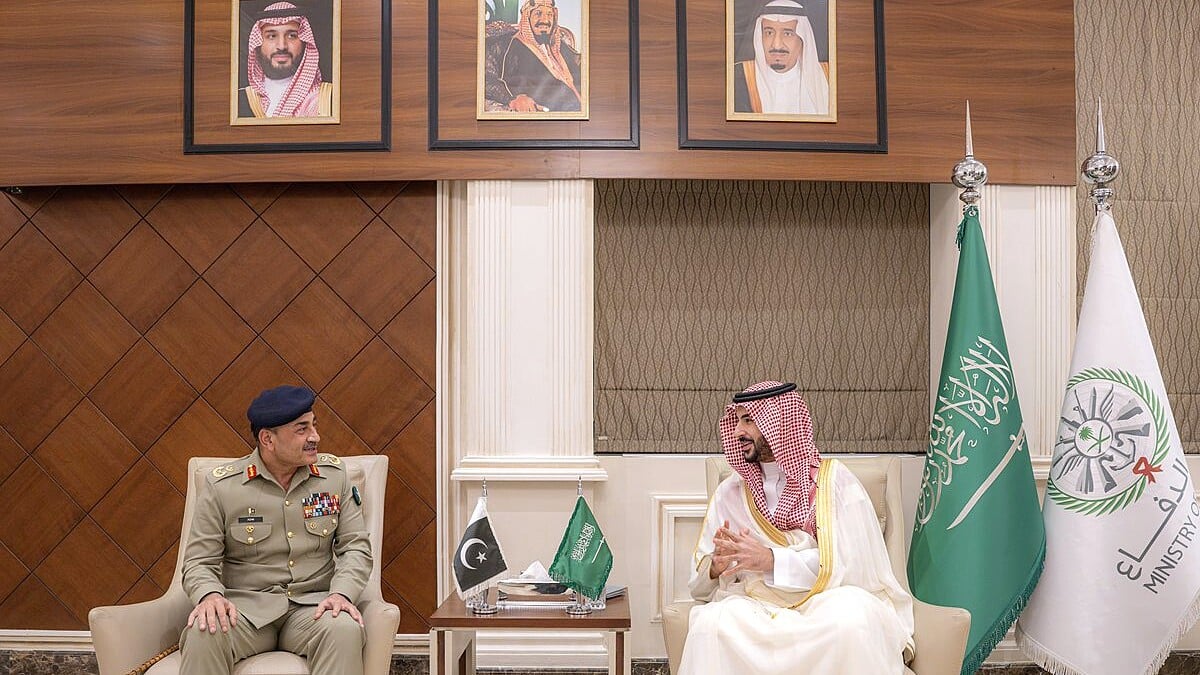
ISLAMABAD: Pakistan and Saudi Arabia have intensified consultations on joint defensive strategies following recent Iranian missile and drone attacks on Saudi territory, according to high-level military engagements.
The meeting between Pakistan’s Chief of Defence Forces and Chief of Army Staff Field Marshal Syed Asim Munir and Saudi Arabia’s Defence Minister Prince Khalid bin Salman took place in Riyadh on Saturday.
Discussions centered on the gravity of the security situation stemming from Iran’s retaliatory strikes, which have targeted key Saudi installations amid the broader US-Israel conflict with Iran.
Both sides emphasized coordinated measures to halt these attacks within the framework of the Strategic Mutual Defence Agreement signed in September 2025 between the two nations.
The agreement, formalized by Prime Minister Shehbaz Sharif and Saudi Crown Prince Mohammed bin Salman, treats aggression against one as aggression against both, marking a significant escalation in bilateral defence ties.
Prince Khalid bin Salman stated on social media that the talks addressed Iranian actions undermining regional security and stability.
He expressed hope that Iran would exercise wisdom, prioritize reason, and avoid miscalculations that could further destabilize the region.
Field Marshal Asim Munir’s visit underscores Pakistan’s commitment to supporting Saudi Arabia under the pact, amid reports of intercepted Iranian ballistic missiles and drones targeting sites like Prince Sultan Air Base.
The engagements occur against the backdrop of heightened tensions after US-Israeli strikes reportedly eliminated key Iranian figures, prompting Tehran’s widespread retaliatory operations across the Gulf.
Pakistan finds itself navigating a delicate position, sharing a long border with Iran while maintaining deep historical, economic, and military alliances with Saudi Arabia.
The kingdom has been a major financial supporter of Pakistan, providing billions in aid and oil supplies on deferred payments during economic crises.
In return, Pakistan has historically contributed troops and expertise to Saudi security needs, including during past threats from regional actors.
The 2025 defence pact represents a formalization of these ties, potentially obligating mutual assistance in case of sustained aggression.
Analysts note that Iranian strikes on Saudi assets test the pact’s practical application for the first time since its signing.
Pakistan has publicly conveyed the existence of the agreement to Iranian officials through diplomatic channels, urging restraint to prevent escalation.
Foreign Minister Ishaq Dar has highlighted Islamabad’s efforts to maintain balanced relations with both Tehran and Riyadh, while emphasizing the pact’s relevance.
Pakistan closed border crossings with Iran indefinitely following the escalation, reflecting concerns over spillover effects.
The country has condemned actions that threaten regional peace but avoided direct condemnation of either side in public statements.
Defence cooperation between Pakistan and Saudi Arabia includes joint training exercises, arms transfers, and intelligence sharing, built over decades.
The current crisis raises questions about the potential invocation of the pact’s collective defence clauses if attacks persist.
Observers point to Pakistan’s nuclear capabilities as a strategic deterrent factor in Gulf security calculations.
The meeting signals a proactive approach to deter further Iranian actions through strengthened bilateral coordination.
Both nations stressed the importance of de-escalation to preserve stability in the Middle East, a region critical for global energy supplies.
Pakistan’s role as a mediator in past Saudi-Iran disputes adds complexity to its current positioning.
The kingdom’s interception of recent projectiles demonstrates robust air defences, possibly augmented by international partnerships.
Continued dialogue under the defence framework aims to explore diplomatic and military options to contain the conflict.
The developments highlight shifting alliances in West Asia amid great power involvement.
Pakistan remains committed to safeguarding its strategic interests while promoting peace in the region.
The high-level interaction reflects the urgency of addressing threats that could draw in multiple actors.
As the situation evolves, further consultations are expected to refine joint response mechanisms.