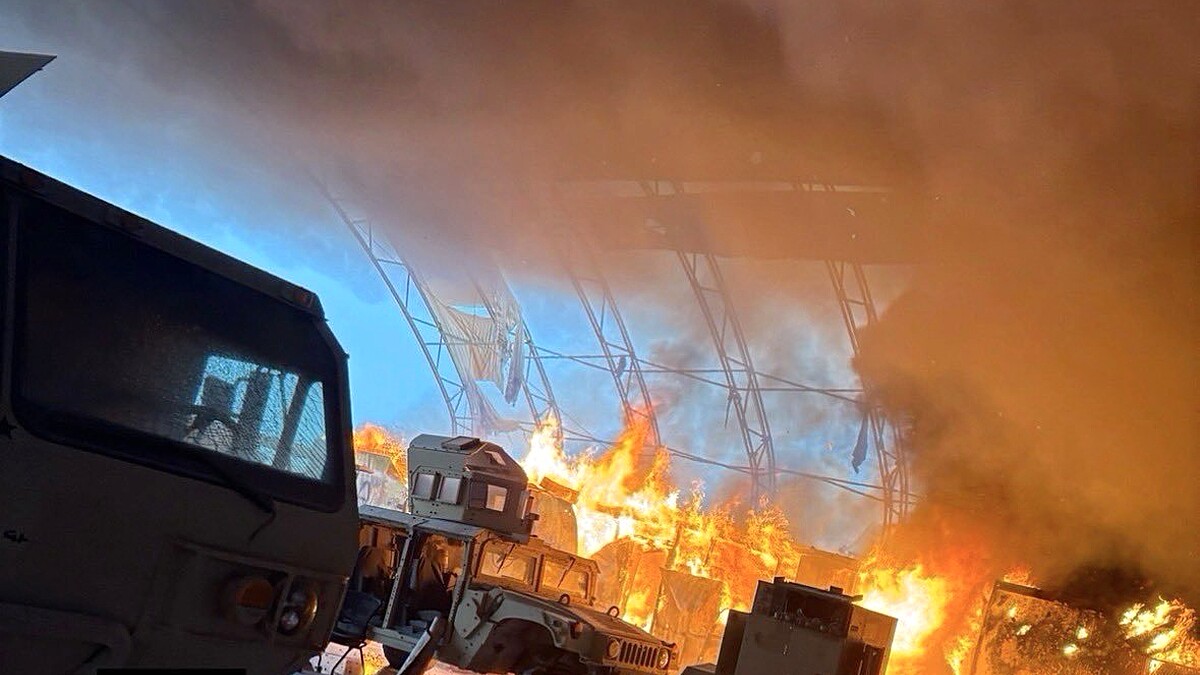
ISLAMABAD: Iranian forces have successfully struck an American-operated Patriot missile defense battery stationed in the United Arab Emirates, marking a significant development in the rapidly escalating conflict involving Tehran, the United States, and regional allies.
The incident, confirmed through photographs shared by credible sources, occurred without reported injuries but highlights the reach and accuracy of Iran’s ballistic missile capabilities. The targeted Patriot site, a key component of layered air defense architecture protecting U.S. military assets and allied infrastructure, sustained visible damage that underscores ongoing challenges to established missile interception systems.
This strike forms part of a broader pattern of Iranian retaliatory actions following recent escalations, including the assassination of Iran’s Supreme Leader and subsequent U.S.-Israeli military operations against Iranian targets. Reports indicate that Iran has launched sustained barrages of ballistic missiles and drones across the Persian Gulf, targeting facilities in the UAE, Bahrain, Qatar, Saudi Arabia, and beyond.
Defense analysts note that the Patriot system, manufactured by Raytheon and valued in the hundreds of millions per battery, serves as a cornerstone of U.S. and allied defenses against short- and medium-range threats. Its penetration in this instance raises questions about the effectiveness of current interception technologies against Iran’s evolving arsenal, which includes maneuverable warheads designed to evade layered defenses such as Patriot and THAAD.
Open-source investigations have documented damage to multiple U.S. military communication and radar installations across at least seven sites in the Middle East during the initial days of intensified hostilities. Such strikes aim to degrade early-warning networks that feed data to Patriot and allied interceptors, potentially reducing overall regional defensive coherence.
The UAE, hosting significant U.S. military presence including at Al Dhafra Air Base, has relied on Patriot batteries alongside indigenous and imported systems to counter threats. Official statements from Emirati authorities have emphasized successful interceptions in many cases, with air defenses reportedly neutralizing a high percentage of incoming projectiles in recent waves. Nevertheless, the direct hit on a Patriot installation demonstrates gaps that Iranian forces appear to exploit through saturation tactics and precision guidance.
Iranian military commanders have claimed that their operations inflict greater damage on U.S. and allied air defense infrastructure than publicly acknowledged. These assertions align with observations of depleted interceptor stockpiles in Gulf states, where sustained barrages could exhaust reserves rapidly. Estimates suggest Patriot missile inventories in some locations might last only days under high-intensity scenarios, given production constraints and the high cost per interceptor.
The broader context reveals Iran’s strategy of imposing asymmetric costs on adversaries. By targeting high-value assets like Patriot systems, Tehran seeks to complicate U.S. and allied operations while highlighting the economic burden of prolonged defense engagements. Each successful penetration amplifies concerns over resupply logistics and the sustainability of current defensive postures.
Regional responses have included urgent requests for additional interceptors and allied support to bolster air defenses. The Gulf Cooperation Council and European partners have issued joint condemnations of Iranian actions, calling for an immediate cessation. Meanwhile, civilian impacts persist, with reports of strikes affecting airports, hotels, and energy facilities, resulting in casualties among foreign workers and locals.
The strike on the Patriot site arrives amid warnings that the pace of Iranian missile and drone launches could outstrip defensive resupply efforts. Analysts emphasize the need for rapid replenishment of interceptors to maintain deterrence, as prolonged attrition favors the side capable of sustained low-cost production.
This development further complicates diplomatic efforts to de-escalate tensions. With U.S. military casualties reported in related incidents and evacuations underway from vulnerable areas, the conflict’s expansion into Gulf territories underscores the risks of wider regional involvement.
As hostilities continue, the incident serves as a stark reminder of evolving military dynamics in the Middle East, where technological superiority faces tests from innovative offensive strategies and sheer volume of fire.