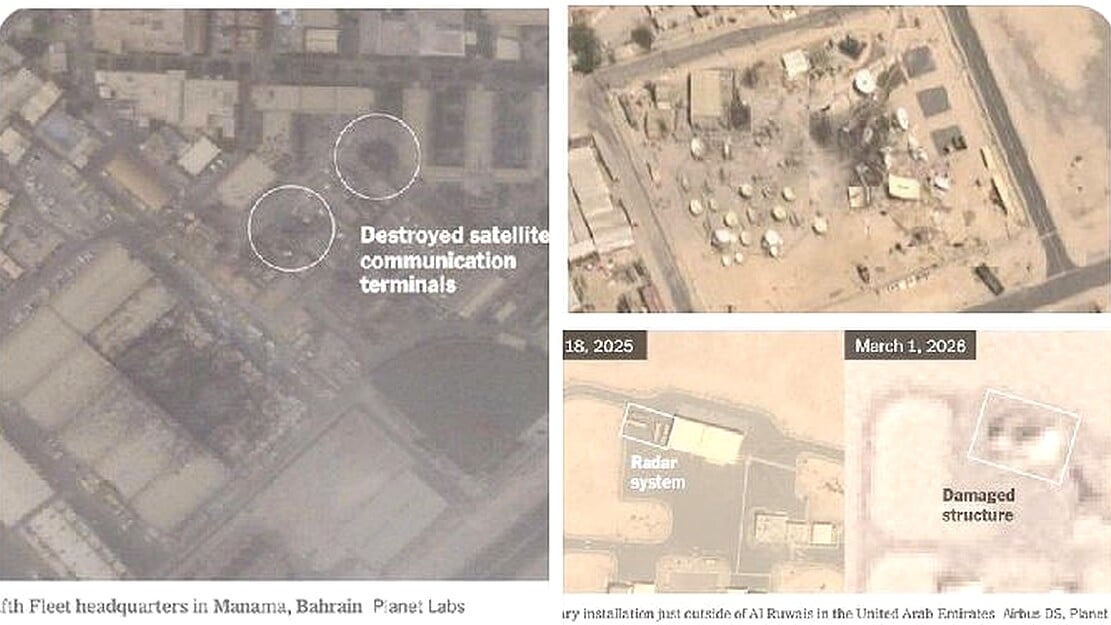
ISLAMABAD: The New York Times has published satellite imagery analysis confirming significant damage to United States military communication and radar infrastructure at bases across the Gulf region following Iranian retaliatory strikes.
The images, examined by the newspaper’s visual investigations team, show targeted destruction at facilities in at least five countries hosting American forces.
These include Bahrain, Qatar, Kuwait, Saudi Arabia and the United Arab Emirates.
The strikes, which occurred over the weekend and into early this week, appear to focus on elements critical to US command, control and missile defense coordination rather than broad infrastructure.
In Bahrain, video verified by The New York Times depicted an Iranian one-way attack drone striking a radome at the US Navy’s Fifth Fleet headquarters in Manama.
This base serves as the primary hub for coordinating American naval operations in the Middle East.
Satellite imagery revealed two AN/GSC-52B SATCOM terminals demolished, impairing high-capacity, near real-time military communications.
In Qatar, at Al Udeid Air Base, images from Sunday afternoon indicated a tent surrounded by satellite dishes was destroyed.
A major early-warning radar system, identified as the AN/FPS-132 valued at approximately $1.1 billion, sustained damage from a missile strike, according to reports corroborated by Qatari officials.
This radar provides long-range detection and tracking of ballistic missiles, feeding data to systems like Patriot and THAAD.
Kuwait saw strikes at Camp Arifjan, where US officials reported three service members killed and five seriously wounded, alongside damage at Ali Al Salem Air Base and Camp Buehring.
Imagery showed damage near radomes and satellite communications structures.
In Saudi Arabia, potential impacts appeared near a radome at Prince Sultan Air Base, possibly affecting an AN/TPY-2 radar site.
The United Arab Emirates experienced hits at facilities including one associated with a THAAD system.
Iranian sources claimed destruction of an AN/TPY-2 radar component at Al-Ruwais, estimated at $500 million, with open-source imagery suggesting confirmation.
Analysts note that the AN/TPY-2 radar, a key X-band phased-array system, detects and tracks ballistic missiles over vast distances, enabling coordination of theater-wide defenses.
Damage to supporting infrastructure, such as power, cooling and data-processing facilities adjacent to these radars, could impair functionality even if the arrays themselves remain intact.
The pattern indicates a deliberate strategy to disrupt the integrated network linking US missile interceptors across the region.
By targeting SATCOM terminals, radomes and radar-adjacent buildings, Iran has systematically challenged the communication and coordination layer essential for unified missile defense operations.
Experts suggest this approach reflects decades of observation of American military architecture in the Gulf.
The strikes coincide with broader escalation since late February, when US and Israeli forces initiated operations against Iranian targets.
Iran responded with missiles and drones aimed at US assets and regional interests.
Reports indicate reduced reaction times for remaining US defenses, as long-range tracking capabilities are compromised, leaving primarily short-range local radars operational.
This shift could limit early warning from 15-20 minutes to one to two minutes in some scenarios, according to defense analysts.
The destruction of high-value assets, including advanced radars tied to THAAD and Patriot batteries, represents a substantial setback.
Combined estimates place losses at nearly $2 billion in equipment during the initial days of intensified conflict.
US Central Command has declined detailed comment on specific damages, citing classification.
The revelations underscore vulnerabilities in forward-deployed US forces amid heightened tensions.
As the conflict evolves, the focus on degrading surveillance and coordination capabilities highlights a shift toward asymmetric targeting of high-tech dependencies.
Iran’s actions demonstrate a calculated doctrine aimed at the sensors and networks that enable American power projection in the region.
The New York Times analysis, based on commercial satellite providers and verified videos, provides rare public insight into the tactical outcomes of these exchanges.
Military observers warn that restoring full operational capacity may require significant time and resources, potentially altering deterrence dynamics in the Gulf.
The episode illustrates the evolving nature of modern warfare, where precision strikes on enabling systems can yield outsized strategic effects.