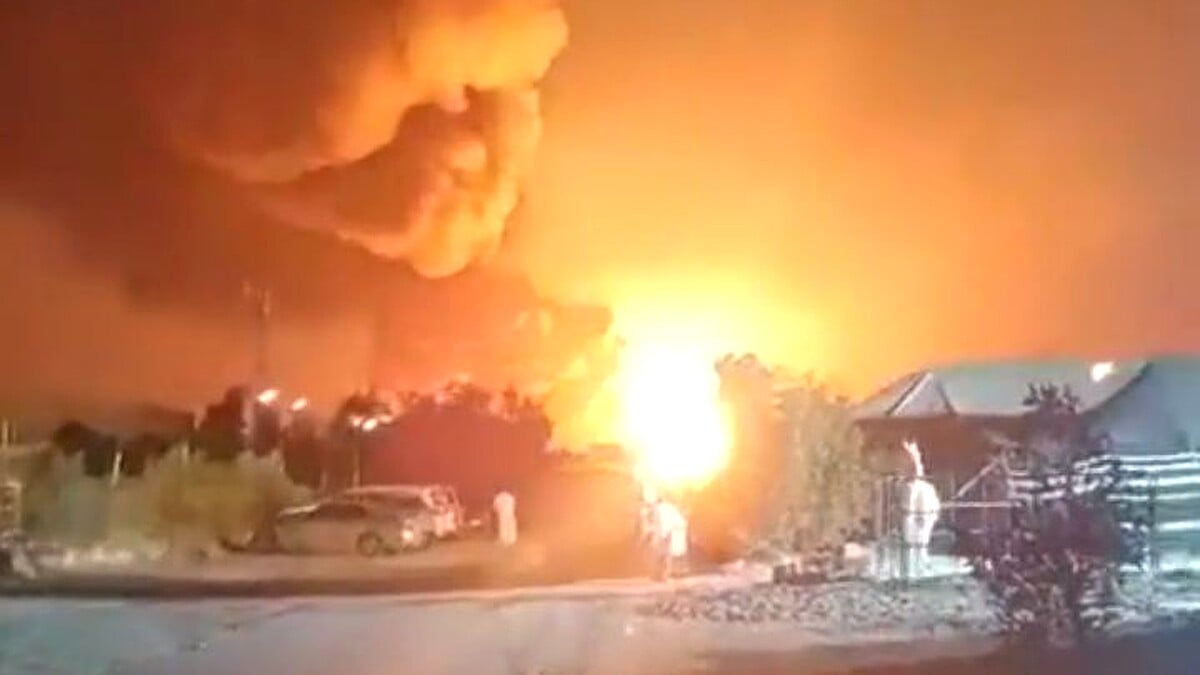
ISLAMABAD: Iranian drones struck the US-operated Ali Al Salem Air Base in Kuwait, escalating regional hostilities following recent joint US and Israeli military operations against Iran.
Reports from local and international sources indicate the attack involved a kamikaze drone, possibly a Shahed-136 model, impacting facilities at the base, which hosts American air force personnel and supports regional operations.
Satellite imagery reviewed by multiple outlets revealed damaged roofs and structures at Ali Al Salem, with at least four impact points identified inside the US section of the installation.
The strike forms part of a broader wave of Iranian retaliatory actions across the Middle East, including missile and drone barrages targeting US assets in Iraq, Bahrain, Qatar, and other Gulf locations.
Iran’s military, including the Islamic Revolutionary Guard Corps, claimed responsibility for targeting Ali Al Salem, stating that ground and naval missile units launched attacks using cruise missiles and drones in response to the killing of Iran’s supreme leader in prior strikes.
Tehran described the operation as hitting the base along with enemy vessels in the northern Indian Ocean, emphasizing precision in their announcements.
US officials confirmed casualties from related Iranian actions in Kuwait, though specific details for Ali Al Salem focused on material damage rather than fatalities at that site.
In a connected incident, an Iranian drone evaded air defenses to strike a tactical operations center at Port Shuaiba, a civilian port near Kuwait City, more than 10 miles from main army bases.
That attack killed six American soldiers from the 103rd Sustainment Command, who had relocated to the port seeking better protection.
The victims included Capt. Cody Khork, Sgt. 1st Class Noah Tietjens, Sgt. Declan Coady, and 1st Class Nicole Amor, with two others unnamed pending notification.
Pentagon statements noted the drone penetrated layered defenses, striking unprotected trailers despite T-wall barriers, highlighting vulnerabilities in forward-deployed force protection.
Kuwaiti authorities reported intercepting numerous incoming threats, with debris from missiles and drones causing light injuries to three Kuwaiti personnel and material damage at Ali Al Salem.
The base, located about 60 kilometers north of Kuwait City, serves as a key hub for US Air Force activities, including transport and combat support in the Gulf.
Recent events saw US fighter jets crashing in Kuwait, though crews survived, amid confusion from ongoing strikes and possible friendly fire incidents.
Iran’s actions follow intense US-Israel bombardments on Iranian targets, which Tehran vowed to avenge through multi-front responses.
Analysts observe that the use of low-cost, long-range drones like the Shahed series allows Iran to project power asymmetrically, challenging advanced US air defense systems such as Patriot and THAAD batteries in the region.
The strikes have disrupted operations at several bases, with satellite photos showing crippled radar domes and SATCOM terminals across Gulf installations.
Kuwait’s Ministry of Defense activated emergency protocols, securing sites and issuing alerts as attacks unfolded over 24-36 hours.
Broader implications include heightened risks to shipping in the Strait of Hormuz and potential impacts on global energy markets from Gulf instability.
US President Donald Trump and defense leaders warned of likely additional casualties as operations continue.
The Pentagon emphasized ongoing assessments of base vulnerabilities, with questions raised about relocating personnel to civilian areas without adequate hardening.
Iran’s state media portrayed the strikes as measured retaliation, while Western sources described them as dangerous escalations risking wider conflict.
Regional allies like Saudi Arabia and the UAE reported related incidents, including drone strikes on refineries, though contained.
Kuwaiti officials downplayed overall damage, focusing on defensive successes in intercepting most threats.
The incident underscores the volatile security environment in the Gulf, where US military presence faces direct challenges from Iranian proxies and state forces.
Observers warn that further tit-for-tat actions could draw in more actors, complicating de-escalation efforts.
Military experts highlight the evolving drone threat, noting how inexpensive systems can overwhelm expensive countermeasures through sheer volume.
The attack on Ali Al Salem, combined with Port Shuaiba losses, marks a significant blow to US posture in Kuwait, a longstanding host of American troops since the 1991 Gulf War.
As investigations proceed, the full extent of damage and strategic fallout remains under review by coalition partners.