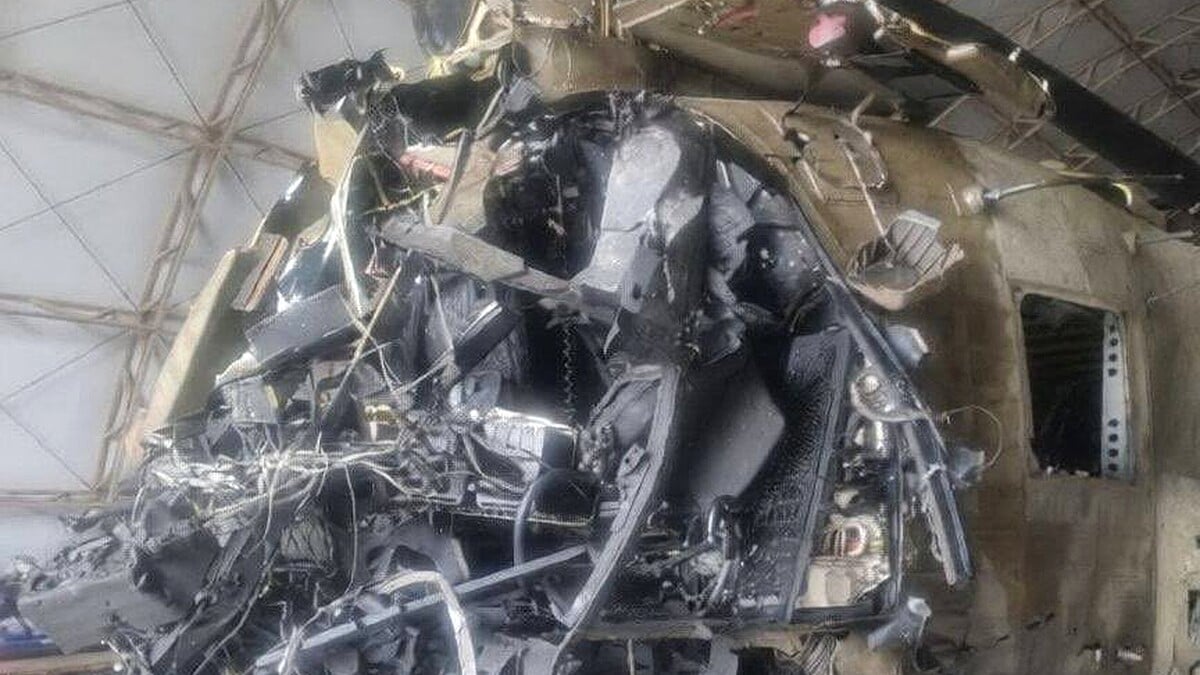




ISLAMABAD: Satellite imagery from Camp Buehring in Kuwait and photos circulating on X reveal collapsed helicopter hangars with visible CH-47 Chinook wreckage inside.
Iranian drones struck the US base today destroying critical heavy-lift helicopters on the ground.
The hangars were not hardened structures and the helicopters were not dispersed making them easy targets.
Each Iranian Shahed drone costs between 20000 and 50000 dollars according to multiple estimates.
In contrast a single Patriot PAC-3 interceptor missile costs between 4 and 5 million dollars.
This massive cost disparity defines the current asymmetric conflict in the region.
Consider a typical salvo of 100 drones targeting a defended base.
Ninety intercepted by Patriots would cost the defender 400 million dollars in missiles.
The 100 attacking drones would cost the attacker merely 2 million dollars.
The 10 that penetrate cause catastrophic damage including ruined hangars and burning Chinooks.
Such exchanges quietly challenge the sustainability of the American way of war.
On March 10 Iranian strikes also targeted the AN/TPY-2 radar in Jordan.
This radar serves as the eyes of both THAAD and Patriot systems.
The AN/TPY-2 unit costs approximately 1.4 billion dollars.
Missiles aimed at it represented only a fraction of that value.
Similar attacks hit the AN/FPS-132 radar in Qatar.
Iran focused on blinding the guidance systems rather than overwhelming interceptors directly.
The destruction at Camp Buehring connects directly to broader operational challenges.
The CH-47 Chinook is the US Army primary heavy-lift helicopter.
It transports troops ammunition fuel and equipment across the theatre.
In scenarios involving downed F-15E fighters inside Iran combat search and rescue missions rely heavily on Chinook logistics support.
Destroyed aircraft today will impact supply chains needed in coming weeks and months.
At Habshan in Abu Dhabi the air defence shield functioned yet the gas plant still caught fire.
Debris from successful interceptions rained down igniting infrastructure below.
Defence systems thus create secondary damage even when they succeed.
Either threats penetrate or interception wreckage causes fires and destruction.
Both warheads and spent boosters weigh hundreds of kilogrammes and obey gravity.
Iran has mastered the economic equation that strains even the largest defence budgets.
Interception routinely costs 100 to 250 times more than the attack.
Every salvo transfers wealth from defender to attacker in material terms.
The proposed 1.5 trillion dollar defence budget includes 12 billion for Project Vault to replenish stockpiles.
This allocation purchases approximately 2400 PAC-3 interceptors at current prices.
Iran could field the equivalent drone force for around 120 million dollars.
Stockpile replenishment thus becomes a limited response to the scale of the problem.
Six soldiers were reported dead at the port on March 1 amid related strikes.
The incidents compound logistical strains across US and allied positions.
The radars have been targeted the interceptors are depleting and helicopters lie in ruins.
The pilot requiring rescue in hostile terrain now faces a defender whose victory becomes more expensive than defeat.
This pattern of low-cost high-impact strikes continues to reshape regional security calculations.
Regional media reports have highlighted the vulnerability of forward deployed high-value assets.
International coverage remains limited leaving circulation of imagery on X as primary visual evidence.
Analysts note that without architectural changes to air defence the asymmetry will persist.
The physics and economics favour the attacker in volume-based drone campaigns.
US forces must now reassess basing dispersal hardening and response doctrines.
The burned Chinooks symbolize a larger strategic recalibration underway.