



ISLAMABAD: In a high-stakes rescue mission deep inside Iran, United States special operations forces successfully extracted the second crew member of a downed F-15E Strike Eagle but left behind and destroyed critical assets worth tens of millions of dollars.
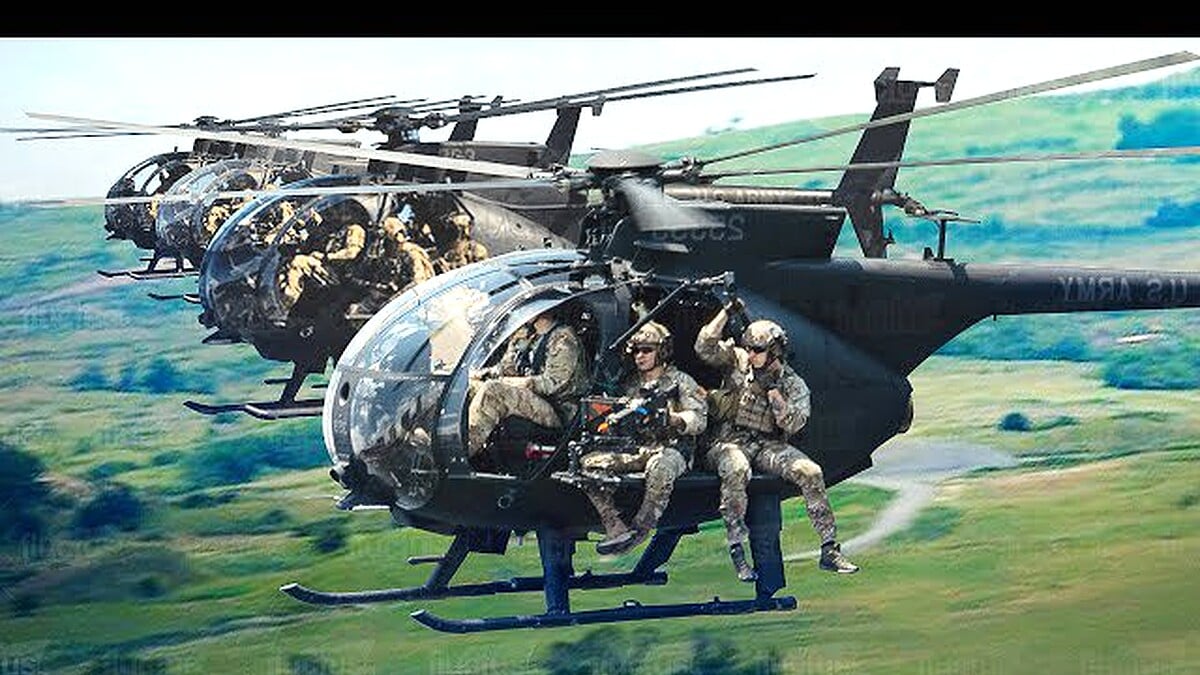
According to an informed US military source cited by ABC News, not one but four MH-6 Little Bird helicopters had to be abandoned at the forward landing site.
These lightweight, highly manoeuvrable helicopters from the elite 160th Special Operations Aviation Regiment, known as the Night Stalkers, were intentionally destroyed to prevent capture by Iranian forces.
The same austere airfield also witnessed the deliberate demolition of two MC-130J Commando II variants of the C-130 Hercules.
These special operations transport aircraft became stuck due to mechanical issues and terrain constraints during the rapid insertion and extraction phase.
Defence analysts estimate the combined value of the two C-130s at over 150 million dollars while each MH-6 Little Bird carries a replacement cost exceeding 5 million dollars.
During the broader operation supporting the rescue, two MQ-9 Reaper drones were also shot down by Iranian air defences.
Each Reaper, a cornerstone of US intelligence, surveillance and strike capabilities, is valued at approximately 30 million dollars, pushing the immediate hardware loss from this single mission into significant territory.
The mission unfolded after an F-15E Strike Eagle was shot down over central Iran, marking a rare success for Iranian defences against a manned US combat aircraft.
One crew member was rescued earlier while the second airman remained isolated for nearly two days in hostile terrain near strategic sites around Isfahan.
US forces established a temporary forward arming and refuelling point, or FARP, at an improvised airfield deep in Iranian territory.
Imagery analysed by outlets including The War Zone shows burned-out wrecks consistent with at least one MH-6 Little Bird and the hulks of the two C-130s at the site.
Replacement aircraft had to be flown in to complete the extraction of the special operations team and the rescued airman.
Iranian state media and the Islamic Revolutionary Guard Corps claimed several enemy flying objects were destroyed during the operation.
Tehran reported downing a transport plane and multiple helicopters in the Isfahan region while releasing footage of debris.
US officials maintained that the fixed-wing and rotary assets were self-destructed on the ground rather than lost in direct combat.
The operation has been described by some US sources as one of the most complex rescue efforts in recent memory, conducted under the shadow of active Iranian air defences.
The MH-6 Little Bird, capable of carrying up to six troops or operating in extreme nap-of-the-earth profiles, played a key role in ferrying personnel from the stuck C-130s to the pickup location in mountainous terrain.
Its abandonment highlights the extreme risks taken to recover the airman before Iranian ground forces could locate him.
Broader context reveals mounting US drone losses in the ongoing tensions.
Reports indicate the United States has lost at least 16 MQ-9 Reaper drones across related operations against Iran, with cumulative costs approaching 480 million to 500 million dollars.
These unmanned systems provide persistent surveillance but have proven vulnerable to Iran’s layered air defence network, including surface-to-air missiles deployed around key nuclear and military facilities.
The rescue success comes amid heightened rhetoric from Washington, with President Donald Trump reportedly calling the mission one of the most daring in US military history.
Yet the material losses underscore the high price of operating inside defended Iranian airspace.
Satellite and open-source imagery confirm the location of the forward base outside Isfahan, a city housing critical Iranian air bases, missile units and sensitive installations.
The decision to destroy rather than attempt recovery of the C-130s and Little Birds reflects standard US doctrine to deny advanced technology and sensitive equipment to adversaries.
Each MC-130J features terrain-following radar, advanced avionics and special mission modifications that could yield valuable intelligence if captured intact.
Similarly, the MH-6 fleet carries classified night-vision and communication systems unique to special operations aviation.
Iranian claims of downing additional helicopters and a transport aircraft add layers of conflicting narratives that military watchers continue to analyse.
While US accounts emphasise self-destruction at the landing site, regional reports from Iranian outlets insist on direct hits by air defences.
The full extent of damage to supporting assets, including reports of damaged HH-60 Black Hawks in related phases, remains under review by defence analysts.
This episode illustrates the operational challenges facing US forces in contested environments where even successful missions incur substantial equipment costs.
The rescued airman’s return marks a tactical victory, yet the visible wreckage at the Iranian airfield serves as a stark reminder of the risks involved.
Further details on the mission timeline and exact circumstances of the F-15E downing are expected to emerge as after-action reviews proceed in Washington.