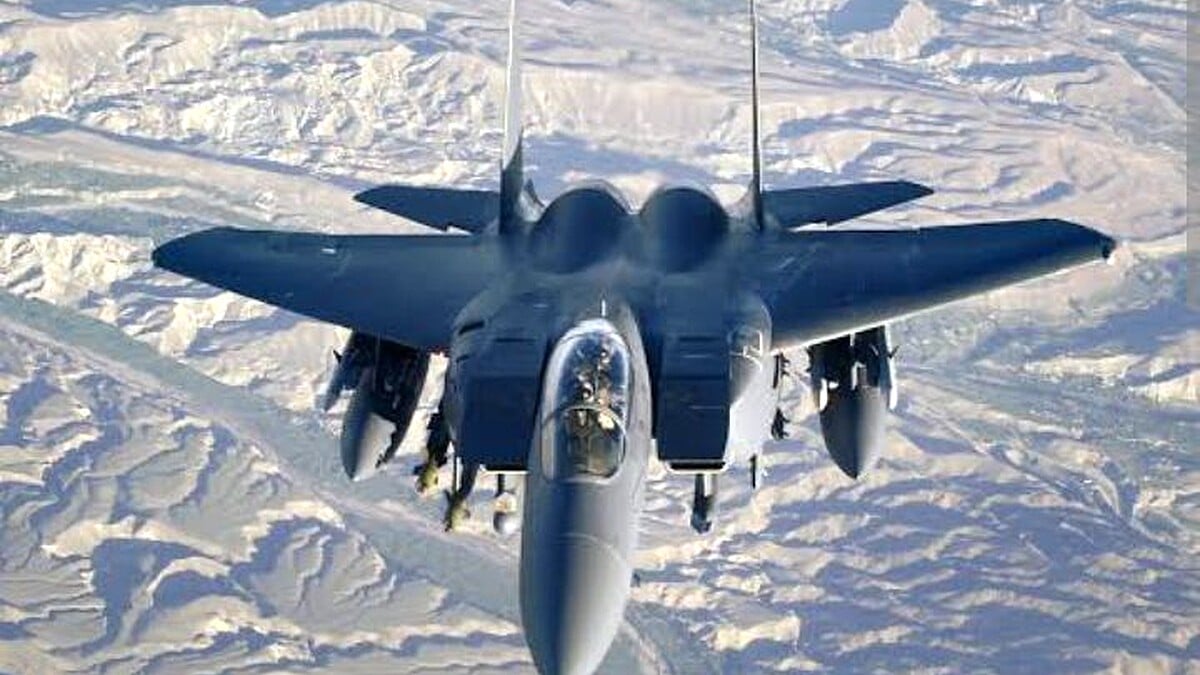
ISLAMABAD: Iran’s Revolutionary Guard Corps has claimed responsibility for shooting down a United States F-15E Strike Eagle fighter jet near the country’s southwestern borders, according to reports from semiofficial Iranian media. The allegation surfaced amid escalating military tensions in the region.
The claim originated from the Islamic Revolutionary Guard Corps (IRGC), which described the incident as a successful engagement by its advanced air defence systems. Tasnim news agency, citing IRGC sources, reported that the twin-seat, multi-role strike fighter was targeted and crashed along Iran’s southwestern frontier. No specific timing or additional evidence, such as wreckage details or pilot status, was provided in the initial statements.
Al Jazeera cited Tasnim in disseminating the report, highlighting the IRGC’s assertion that the aircraft belonged to the United States and was operating in a hostile manner near Iranian territory. Such claims have become frequent in the context of ongoing confrontations, where both sides seek to project strength through media narratives.
The US Central Command (CENTCOM) responded promptly on social media platform X, dismissing the rumours outright. It stated that reports circulating about a US F-15E crash in Iran early Wednesday were baseless and not true. This denial aligns with previous US positions during recent escalations, where misinformation has proliferated amid active combat operations.
The F-15E Strike Eagle is a key asset in the US Air Force inventory, designed for long-range interdiction and air-to-ground missions. It features advanced avionics, twin engines, and substantial payload capacity, making it a mainstay in Middle East deployments. Recent operations have seen these aircraft involved in strikes supporting broader campaigns against Iranian assets.
This latest allegation follows a pattern of conflicting accounts in the region. Earlier this week, three US F-15E Strike Eagles were lost over Kuwait in what CENTCOM described as a friendly fire incident involving Kuwaiti air defences. All six crew members ejected safely and were recovered in stable condition during that event, which occurred amid intense Iranian retaliatory actions including missiles and drones.
Iranian media had previously claimed credit for those Kuwait incidents, asserting that Iranian forces targeted the jets despite US explanations of misidentification by allied defences. Such discrepancies underscore the challenges in verifying battlefield reports in real time, particularly when propaganda plays a significant role.
Military analysts note that Iran’s air defence network, bolstered by systems like the Bavar-373 and upgraded Russian-origin equipment, has been positioned to counter aerial incursions. The IRGC’s aerospace division frequently highlights intercepts to bolster domestic morale and deter perceived threats.
However, independent verification of the latest claim remains absent. No satellite imagery, debris photos, or third-party confirmations have emerged to substantiate the downing inside Iranian borders. Social media rumours often amplify unverified assertions, leading to rapid denials from involved parties.
The broader context involves heightened US-Iran hostilities, including joint operations with allies targeting Iranian military infrastructure. These have resulted in significant naval and air engagements, with both sides reporting successes while downplaying losses.
US officials have consistently emphasized operational security and the robustness of coalition forces in the theatre. CENTCOM maintains that no aircraft losses have occurred over Iranian territory in the manner described.
Observers point out that such claims serve strategic purposes, including rallying internal support within Iran and projecting defiance internationally. The IRGC, designated a terrorist organisation by several countries including the United States, often uses state-linked outlets like Tasnim and Mehr News to disseminate its versions of events.
In contrast, US military communications prioritise factual corrections to counter disinformation campaigns. The quick rebuttal on X reflects efforts to maintain credibility amid information warfare.
Regional stability remains precarious as incidents like these risk further escalation. Diplomatic channels have been strained, with calls from international actors for de-escalation amid fears of wider conflict.
The incident, if confirmed, would mark a notable achievement for Iranian defences against advanced US platforms. Yet the immediate and categorical US denial suggests it may join a list of unproven assertions in this volatile period.
As developments unfold, reliance on corroborated sources from multiple perspectives will be essential to separate fact from narrative in this ongoing confrontation.