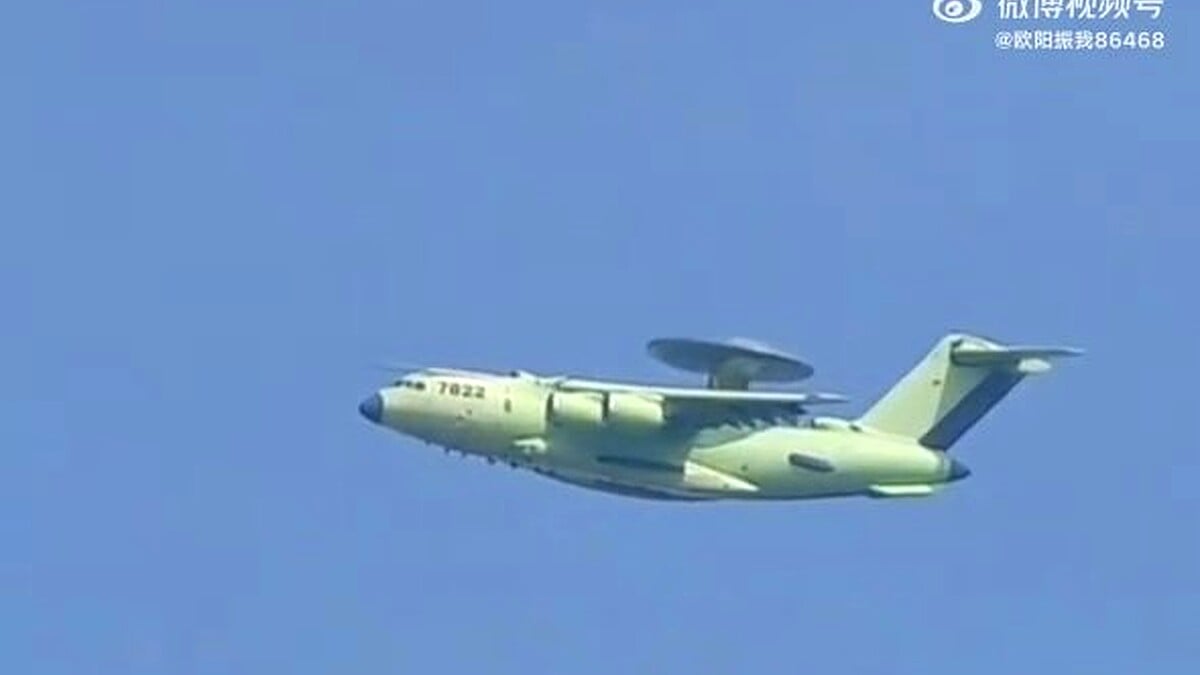
ISLAMABAD: A second prototype of China’s KJ-3000 airborne early warning and control aircraft has reportedly been sighted, intensifying global attention around what Chinese defence sources describe as the most powerful AEW&C platform ever developed. With claims of hosting the largest and most advanced radar array ever mounted on an aircraft, the development signals a significant leap in aerial surveillance capability — and Pakistan is widely expected to become one of its early foreign operators.
The emergence of a second KJ-3000 platform indicates that the programme has moved beyond preliminary testing into a more advanced evaluation phase. Defence analysts interpret the appearance of multiple airframes as a sign of rapid development and potential limited serial production in the near term. In military aviation, the deployment of additional prototypes often reflects confidence in both the aircraft’s structural performance and its mission systems.
The KJ-3000 is believed to be built on a large strategic transport airframe, reportedly derived from China’s Y-20 heavy-lift aircraft programme. This provides the platform with extended endurance, high-altitude capability and substantial onboard power generation — critical factors for operating next-generation radar arrays. Unlike earlier AEW&C platforms that rely on smaller turboprop or modified commercial jet airframes, the KJ-3000’s size allows for heavier, more energy-intensive electronic systems.
Chinese defence commentators claim the aircraft carries a new generation active electronically scanned array radar with multi-band capability. Such radars are capable of tracking hundreds of aerial and maritime targets simultaneously while maintaining resistance to electronic countermeasures. Multi-band systems are particularly significant because they combine long-range detection with improved stealth aircraft tracking, addressing a known vulnerability in earlier radar generations.
AEW&C aircraft serve as airborne command centres, extending a country’s radar horizon far beyond ground-based systems. By operating at high altitude, they can detect incoming aircraft, cruise missiles, and potentially even hypersonic threats at far greater distances. They also coordinate fighter jets, air defence batteries, and naval units in real time. In modern network-centric warfare, these platforms form the backbone of integrated air defence systems.
China currently operates platforms such as the KJ-2000 and KJ-500, both of which have enhanced the People’s Liberation Army Air Force’s long-range surveillance capability over the past decade. The introduction of the KJ-3000, however, suggests an ambition to compete directly with leading Western systems such as the United States’ E-3 Sentry and E-7 Wedgetail. The scale of the KJ-3000’s radar dome and its airframe size indicate a system designed for global-range operations rather than regional patrol missions alone.
For Pakistan, the potential acquisition of the KJ-3000 would mark a transformative upgrade to its existing airborne early warning fleet. The Pakistan Air Force currently operates Chinese-origin ZDK-03 Karakoram Eagle aircraft alongside Swedish Saab 2000 Erieye platforms. While these aircraft provide credible regional surveillance capability, a heavier platform like the KJ-3000 would significantly expand detection range, endurance, and command capacity.
Security analysts argue that Pakistan’s evolving threat environment, particularly the increasing integration of advanced fighter aircraft and long-range missile systems in South Asia, necessitates enhanced airborne surveillance. India’s induction of platforms such as the Rafale fighter jet and its ongoing work on indigenous AEW&C systems have altered the regional balance. In this context, a higher-capacity Chinese system would strengthen Pakistan’s ability to monitor airspace and manage coordinated responses.
The reported radar size and processing power of the KJ-3000 suggest a focus not only on conventional aerial threats but also on emerging technologies such as stealth aircraft and stand-off precision weapons. Larger radar arrays typically provide improved resolution and longer detection ranges, while advanced onboard data fusion systems enable quicker threat assessment and decision-making.
Another strategic dimension lies in interoperability. China has steadily deepened defence collaboration with Pakistan across air, naval and missile domains. Integration of the KJ-3000 into Pakistan’s air defence network would likely involve compatibility with Chinese-built fighter aircraft such as the JF-17 Thunder and the J-10C. Such integration enhances data sharing and reduces reaction time in high-intensity scenarios.
Globally, the development also reflects an accelerating race in airborne sensor technology. As nations invest heavily in stealth platforms and hypersonic systems, the countermeasure remains enhanced detection capability. AEW&C aircraft, equipped with high-output radar arrays and secure communication links, represent a strategic equaliser in contested airspace.
While official confirmation regarding export timelines remains limited, defence observers note that China has historically fast-tracked military sales to strategic partners once domestic induction stabilises. If the KJ-3000 completes its flight testing and systems validation within the projected timeframe, export discussions could materialise sooner than anticipated.
The sighting of a second aircraft underscores that the programme is unlikely to be symbolic or experimental. Instead, it signals operational intent. In military procurement cycles, visible production momentum often precedes formal announcements.
For Pakistan, the acquisition would not merely represent an equipment upgrade but a doctrinal shift toward deeper network-centric warfare capability. Enhanced early warning translates directly into greater survivability for fighter fleets, improved missile defence coordination, and stronger maritime surveillance.
As aerial combat evolves with rapid technological shifts, the balance increasingly depends on who sees first and responds fastest. With the KJ-3000 emerging as a potential game-changer in airborne surveillance, South Asia’s strategic calculus may soon witness another significant adjustment.