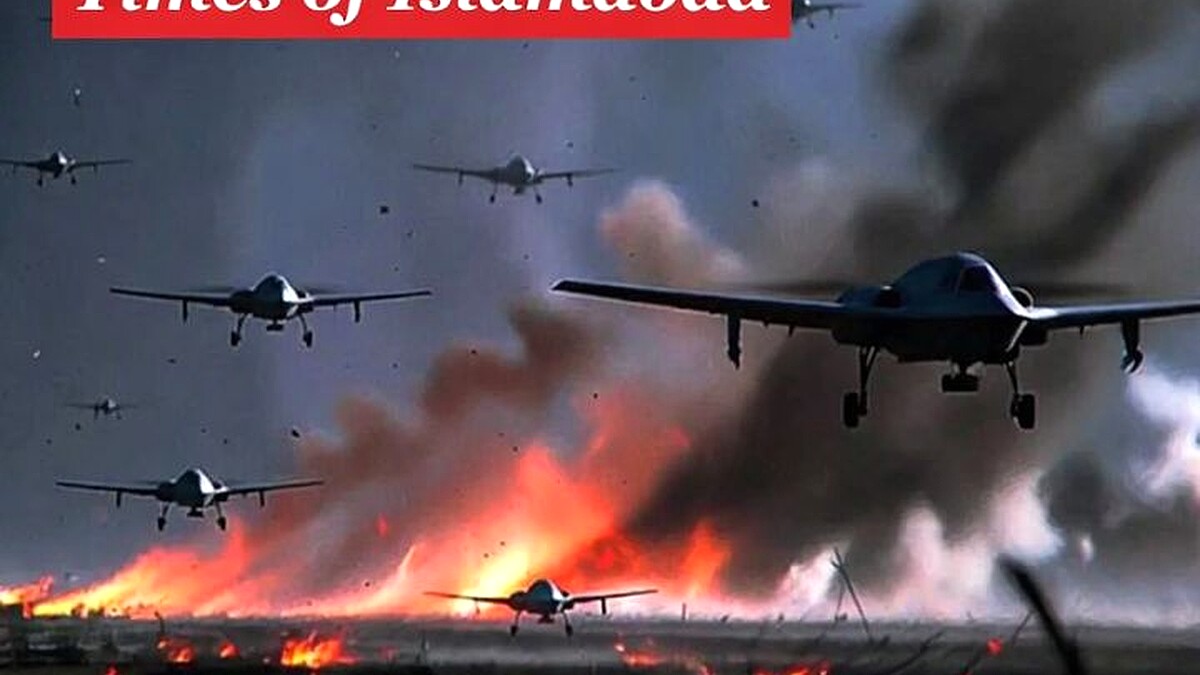
ISLAMABAD: Azerbaijan’s Nakhchivan exclave came under attack on Thursday when drones reportedly launched from Iranian territory struck key infrastructure, injuring two civilians and escalating the regional conflict that has already engulfed multiple countries.
The Azerbaijani Foreign Ministry reported that one drone directly hit the terminal building of Nakhchivan International Airport, while another crashed near a school in the village of Shakarabad, causing material damage and civilian casualties.
This marks the first reported Iranian-linked strike on Azerbaijani soil since the outbreak of hostilities involving the United States, Israel, and Iran earlier this year.
Azerbaijan, a key energy producer and strategic US ally, summoned Iran’s ambassador to Baku to deliver a strong protest, describing the incident as a grave violation of sovereignty and international law.
The ministry demanded urgent explanations from Tehran and warned that Azerbaijan reserves the right to take appropriate retaliatory measures to protect its territory and citizens.
Eyewitness accounts and video footage circulating on social media showed smoke rising from the airport area, with emergency services rushing to the scene to contain the damage and assist the injured.
The Nakhchivan Autonomous Republic, an exclave bordered by Iran to the south and separated from mainland Azerbaijan by Armenia, lies just about 10 kilometers from the Iranian border, making it geographically vulnerable in any cross-border escalation.
Iran’s Deputy Foreign Minister Kazem Gharibabadi swiftly denied the allegations, stating through Tasnim news agency that the Islamic Republic had not targeted the Republic of Azerbaijan.
Iranian officials suggested the incident required thorough investigation, implying possible misdirection or unintended fallout from ongoing military activities in the region.
The strike occurred on the sixth day of intensified US and Israeli operations against Iranian targets, which have included strikes on ballistic missile sites, nuclear-related facilities remnants, and command structures.
In retaliation, Iran has launched missiles and drones toward Israel, US bases in the Gulf, and other regional sites, with reports of strikes reaching as far as Qatar, UAE, Kuwait, and Jordan in previous days.
Azerbaijan’s accusation adds a new front to the conflict, potentially drawing in the Caucasus region and complicating alliances, given Baku’s close ties with Israel and energy partnerships with Western nations.
Experts note that Nakhchivan’s proximity to Iran has long been a point of tension, with past Iranian military drills near the border and warnings against foreign influences in the area.
The incident highlights the risks of spillover in a war that has already affected civilian infrastructure across borders, from airports in the Gulf to urban centers in Israel.
Azerbaijani authorities have emphasized that the attack injured innocent civilians, underscoring the human cost of the broadening hostilities.
International observers have called for restraint to prevent further escalation, as the involvement of additional states could destabilize energy markets and regional security.
The United States has not immediately commented on the Azerbaijan incident, but its ongoing campaign against Iran continues to draw in neighboring countries through retaliatory actions.
This development raises questions about Iran’s command and control over its drone and missile forces during high-intensity operations.
Azerbaijan, which maintains a neutral stance in many Middle Eastern conflicts, now faces direct implications from the war’s expansion.
The Foreign Ministry’s statement reiterated Baku’s commitment to defending its borders while urging diplomatic channels to address the violation.
As investigations continue, the incident serves as a stark reminder of how quickly localized strikes can spiral into wider confrontations in an interconnected geopolitical landscape.