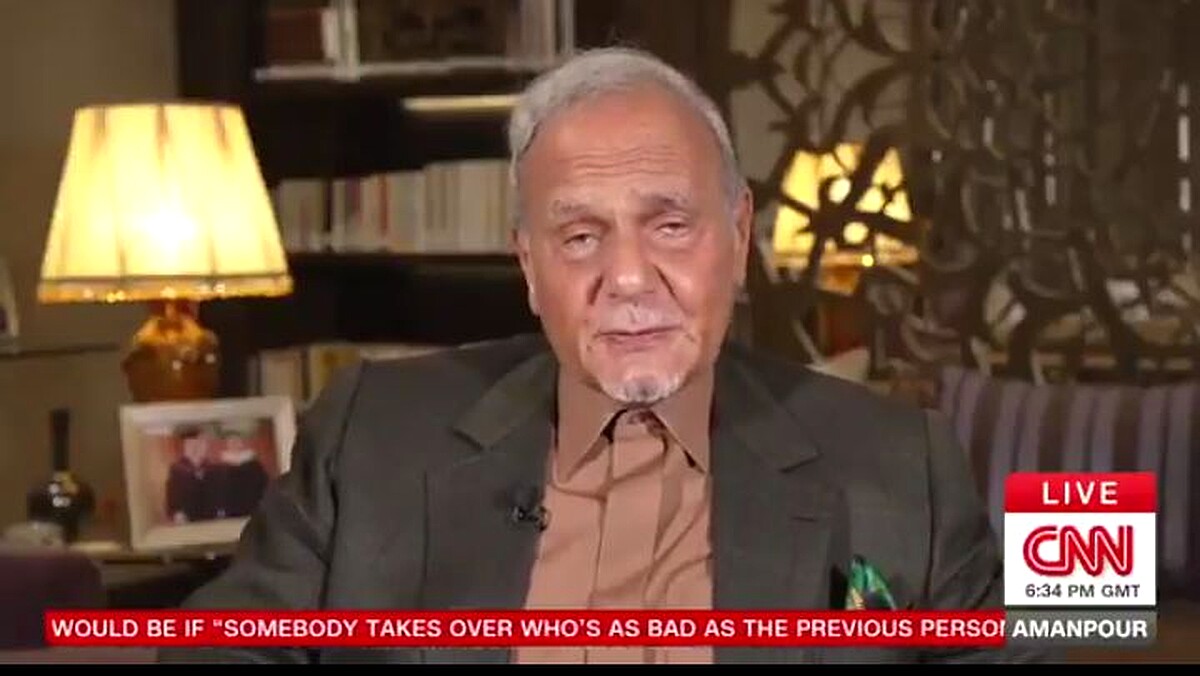
ISLAMABAD: A rare and pointed remark by former Saudi intelligence chief Prince Turki al-Faisal has drawn fresh attention to widening strategic gaps between Washington and its Gulf partners after President Donald Trump appeared surprised by the scale and timing of Iran’s retaliation against Gulf countries.
“I am surprised at the President’s surprise, respectfully,” Prince Turki said in a televised interview, responding to reports that President Trump had been caught off-guard by coordinated Iranian responses targeting strategic infrastructure in the Gulf. The comment, delivered in measured but unmistakably critical tones, has resonated across diplomatic circles already unsettled by escalating tensions in the region.
The exchange underscores a deeper concern among Gulf policymakers: that miscalculations in Washington could trigger consequences for regional states that sit within immediate range of Iranian missiles and proxy networks. While the United States retains unmatched global military power, it is the Gulf’s ports, pipelines, and air bases that are most exposed in any confrontation with Tehran.
According to regional security assessments, Iran possesses one of the largest ballistic missile arsenals in the Middle East, developed steadily over the past two decades despite international sanctions. Analysts estimate that Tehran’s inventory includes short- and medium-range systems capable of reaching critical infrastructure in Saudi Arabia, the United Arab Emirates, Bahrain, and Qatar within minutes.
The backdrop to Prince Turki’s remarks lies in a pattern of tit-for-tat escalation. In recent years, Gulf energy installations have been targeted in drone and missile attacks widely attributed to Iranian-backed groups. The 2019 strikes on oil facilities in eastern Saudi Arabia, which temporarily disrupted nearly five per cent of global oil supply, remain a stark reminder of the vulnerability of even heavily defended sites.
President Trump’s previous administration had adopted a “maximum pressure” strategy aimed at curbing Tehran’s regional influence and nuclear ambitions. That approach included withdrawal from the 2015 nuclear agreement and the reimposition of sweeping sanctions. While the policy strained Iran’s economy, it also coincided with heightened regional confrontation, including attacks on shipping lanes and energy assets.
Prince Turki’s statement suggests that Gulf leaders expected any renewed pressure campaign to factor in the probability of swift Iranian retaliation. His expression of surprise at Washington’s surprise reflects an argument long voiced by regional strategists: that deterrence in the Gulf requires anticipating asymmetric responses rather than assuming conventional restraint.
Security experts note that Iran’s doctrine emphasises calibrated retaliation through a combination of state and non-state actors. The Islamic Revolutionary Guard Corps has invested heavily in missile precision, drone technology, and naval capabilities suited for operations in the confined waters of the Gulf. These tools provide Tehran with multiple levers short of full-scale war.
For Gulf economies, the stakes are profound. The region accounts for roughly a third of globally traded crude oil, and its liquefied natural gas exports are central to Asian and European energy security. Even limited disruptions can send shockwaves through global markets, pushing up prices and unsettling fragile post-pandemic recoveries.
Diplomatic observers say Prince Turki’s remarks should not be read as a rupture in Saudi-American ties, which remain anchored in decades of defence cooperation and intelligence sharing. Rather, they reflect an appeal for more coordinated strategic planning and clearer communication before decisions with regional repercussions are taken.
Within policy circles in Riyadh and Abu Dhabi, there has been a gradual shift toward diversification of security partnerships and cautious dialogue with Tehran. While mistrust persists, backchannel contacts and Chinese-brokered diplomatic initiatives have sought to reduce the risk of miscalculation.
At the same time, Washington continues to maintain a substantial military footprint across Gulf bases, including advanced air defence systems designed to intercept missiles and drones. Yet experts caution that no shield is impenetrable, especially against saturation attacks combining multiple projectiles and flight paths.
Prince Turki, who previously served as ambassador to both Washington and London, has long advocated for a balanced approach that combines firmness with realism. His latest comments appear to reinforce the notion that surprise in geopolitics often signals a failure of intelligence synthesis or strategic foresight rather than a lack of raw capability.
For President Trump, the episode could complicate efforts to project decisiveness on Iran while reassuring allies of American reliability. Domestic political considerations in the United States frequently intersect with Middle Eastern policy, sometimes producing abrupt shifts that regional capitals must quickly interpret.
Ultimately, the exchange highlights a recurring dilemma in Gulf security: how to deter Iran without triggering uncontrollable escalation. It also underscores the premium placed on consultation among allies whose territories lie on the front lines of any confrontation.
As tensions persist, the words from Riyadh serve as both critique and caution. In a region where minutes can separate warning from impact, strategic surprise is rarely a luxury states can afford.