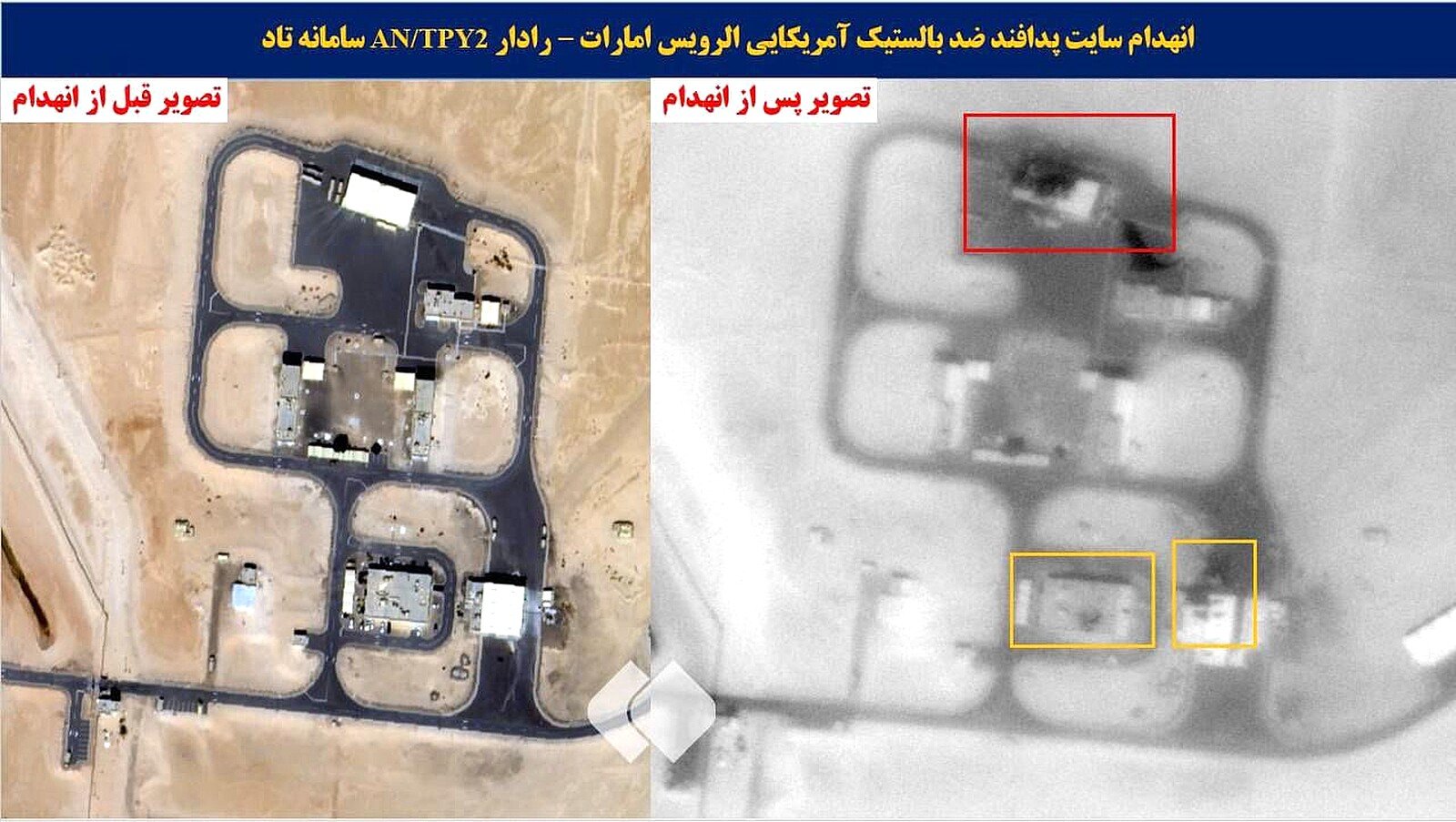
ISLAMABAD: Satellite imagery has verified claims by Iran’s Islamic Revolutionary Guard Corps (IRGC) that a precision missile strike destroyed the American AN/TPY-2 radar linked to the Terminal High Altitude Area Defense (THAAD) system at Al Ruwais in the United Arab Emirates.
The development represents a major setback for United States military positioning in the Gulf region. Analysts describe the incident as a significant breach in the layered missile defense architecture relied upon by Washington and its allies to counter ballistic threats from Iran.
The AN/TPY-2 radar serves as a critical component in missile early warning and tracking. Operating in X-band frequencies, it provides high-resolution detection of incoming projectiles at extended ranges, often exceeding thousands of kilometers in forward-based mode.
Deployment of the system in the UAE dates back to agreements enhancing regional defense cooperation. The United Arab Emirates acquired THAAD batteries, including associated AN/TPY-2 radars, to bolster protection against potential missile attacks. One battery was positioned specifically to safeguard energy infrastructure near Al Ruwais.
IRGC statements, disseminated through state-affiliated media such as Tasnim, asserted that the strike formed part of Operation True Promise 4. This operation comprised multiple waves targeting US-linked assets across the Middle East in retaliation for prior strikes.
Commercial satellite providers, including Planet and Airbus, supplied before-and-after imagery capturing structural damage at the site. Reports indicate visible destruction consistent with a high-precision impact, corroborating IRGC assertions despite absence of official US confirmation.
United States Central Command has refrained from detailed commentary on the specific radar claim. Broader assessments acknowledge Iranian missile barrages reached Gulf locations, prompting air defense activations in the UAE, Kuwait, Bahrain, and Qatar.
The radar’s elimination disrupts integrated surveillance. In terminal mode, the AN/TPY-2 cues THAAD interceptors directly. In forward-based configuration, it feeds data to broader ballistic missile defense networks, including Aegis-equipped vessels and other ground systems.
Loss of this sensor compresses reaction timelines for allied forces. Redundancy exists through space-based infrared detection and additional terrestrial radars, yet gaps emerge in persistent tracking over specific sectors.
Iran’s missile arsenal has evolved to challenge such defenses. Precision-guided ballistic missiles, including variants with maneuverable re-entry vehicles, aim to overwhelm or evade interception layers.
The strike highlights escalating tensions following reported US-Israeli operations against Iranian targets. Retaliatory actions extended to naval assets in the Indian Ocean and facilities in neighboring states.
Regional security implications extend beyond immediate military effects. Energy markets remain sensitive to disruptions in the Gulf, where the UAE hosts vital export terminals.
Diplomatic responses have been measured. The UAE condemned violations of sovereignty while activating defenses. No widespread escalation has followed, though monitoring intensifies.
Experts note that the AN/TPY-2’s mobility allows potential relocation or replacement. However, reconstitution demands time, resources, and logistical coordination amid heightened alert status.
Iran maintains the action was defensive. Tehran frames strikes as proportionate responses to aggression, emphasizing protection of national interests.
The incident underscores shifting dynamics in missile defense efficacy. Advanced systems face increasing threats from proliferating precision weaponry and electronic warfare capabilities.
Broader US posture in the region includes additional sensors and interceptors. Naval assets provide mobile coverage, while Patriot batteries offer complementary lower-tier protection.
Verification through independent satellite analysis strengthens credibility of claims in contested narratives. Such imagery has become instrumental in assessing damage during recent escalations.
The destroyed radar’s role in cueing defenses amplifies strategic impact. Freedom of maneuver for Iranian missile forces potentially increases, altering deterrence calculations.
Observers anticipate further assessments as more data emerges. Full operational ramifications depend on restoration efforts and alternative sensor integration.
The event marks a notable chapter in ongoing confrontations. It illustrates how targeted strikes on high-value assets can influence regional power balances.