ISLAMABAD: Iran’s recalibrated military strategy in its widening confrontation with the United States and Israel appears designed not for immediate battlefield victory, but for strategic attrition — a slow, grinding campaign aimed at raising American costs to unsustainable levels while reshaping the regional balance of power.
The shift follows Tehran’s rejection of ceasefire outreach reportedly conveyed through backchannels associated with US President Donald Trump. Iranian officials and affiliated analysts argue that agreeing to the June ceasefire was a strategic error, one that allowed Washington and Tel Aviv to replenish air defence interceptors, restock precision-guided munitions, and reorganize operational planning before resuming hostilities.
This time, Tehran appears unwilling to repeat that calculation.
Iranian military planners assess that unless the cost imposed on Washington rises significantly — potentially including American casualties — any ceasefire would merely serve as an interlude before renewed attacks. The objective now, analysts suggest, is to alter US strategic calculus by ensuring that continuation of the war becomes politically and militarily untenable.
Unlike the June phase of fighting, when Iran launched large salvos of ballistic missiles in concentrated waves, the current campaign reflects a dispersed and sustained tempo. Smaller numbers of missiles and drones are fired at consistent intervals throughout the day. Damage levels may be lower per strike, but cumulative pressure is constant.
This strategy reflects a sober reading of Israeli resilience. Tehran appears to have concluded that Israel’s threshold for civilian and infrastructural damage remains high as long as American military backing is unwavering. Therefore, the centre of gravity has shifted from Tel Aviv to Washington.
From the outset of this phase, Iran has expanded its target list to include US military installations across the region. Facilities in Iraq, Syria, and Gulf states have faced repeated attacks. Significantly, Iran has also struck bases in Cyprus, including infrastructure linked to British military facilities such as RAF Akrotiri, underscoring a willingness to widen the war’s geographic scope.
The strike calculus seems deliberate. By targeting bases in European jurisdictions and allied Gulf territories, Tehran signals that no participant in the coalition can remain insulated. An attack on a French-linked installation in the United Arab Emirates further illustrated this point. For Iran, a durable end to the war may require not only American pain, but European discomfort as well.
The assassination of Supreme Leader Ayatollah Ali Khamenei — an event that shocked the region — has paradoxically facilitated this strategic shift. Iranian officials declared that with the death of Khamenei, “no red lines remain.” The statement appears less rhetorical than operational.
Iranian commanders now seek to demonstrate that prior restraint was not weakness. For years, sections of the American security establishment interpreted Tehran’s calibrated responses as evidence of deterrence failure. The current campaign attempts to invert that narrative, even at immense domestic cost.
Central to Tehran’s confidence is its arsenal.
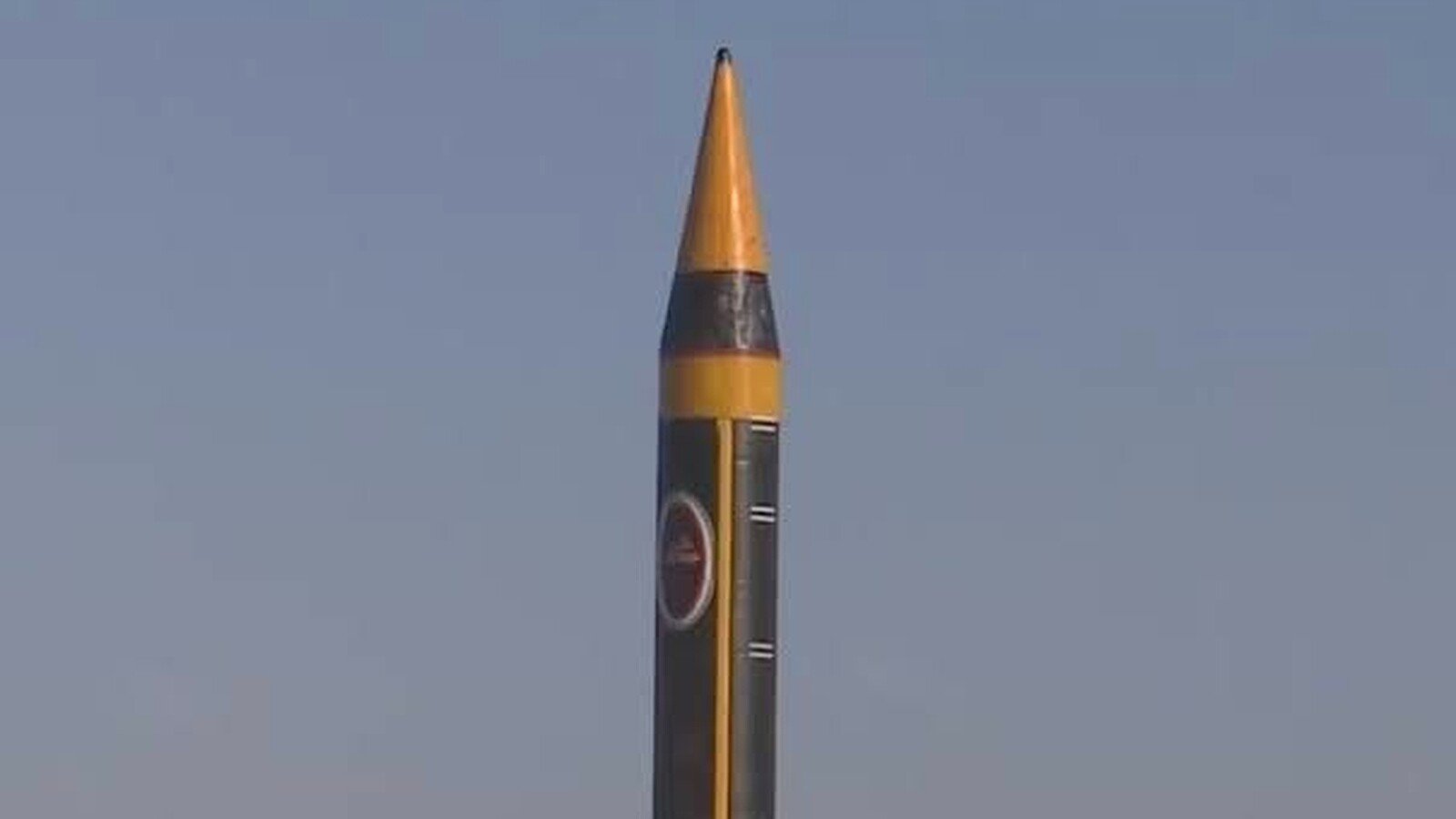
Western intelligence assessments suggest that Iran retains one of the region’s largest stockpiles of ballistic missiles, including medium-range systems capable of reaching US bases across the Gulf and Eastern Mediterranean. In addition, Iran’s hypersonic missile development — though contested in terms of full operational capability — introduces new defensive challenges.
Moreover, Iran’s extensive inventory of low-cost drones allows sustained harassment operations. The combination of ballistic missiles, cruise missiles, and unmanned aerial vehicles enables layered attacks that strain even advanced air defence networks.
By contrast, American and allied interceptor stockpiles are finite. Patriot and THAAD interceptors are expensive and limited in number. Israeli defence systems, while technologically sophisticated, rely heavily on US replenishment pipelines. Military analysts have noted that continuous engagements rapidly deplete defensive inventories.
Reports in The Wall Street Journal have indicated growing concern within Washington about the sustainability of prolonged operations. Discussions about war termination and diplomatic off-ramps are reportedly gaining traction. The notion of regime change in Tehran — once discussed in hawkish circles — now appears unrealistic in official assessments.
Even sustained air campaigns have shown limits. Destroying dispersed missile stockpiles embedded in hardened underground facilities is notoriously difficult. Mobile launchers further complicate targeting. As seen in other conflicts, air superiority does not automatically translate into elimination of missile capabilities.
Beyond military arithmetic lies political pressure.
A prolonged war risks straining American public opinion, particularly if US casualties mount. Iran’s strategy explicitly factors this dimension. Should American soldiers be killed in greater numbers at regional bases, domestic scrutiny of the war’s rationale would intensify.
Critics within the United States have already begun framing the conflict as fundamentally an Israeli war that Washington has adopted as its own. The perception that American forces are paying the price for another state’s strategic objectives could deepen partisan divides ahead of elections.
Internationally, allied unease is also visible. European governments face energy market volatility, refugee concerns, and domestic anti-war sentiment. Gulf states hosting US bases confront internal vulnerabilities if Iranian retaliation continues. An extended conflict amplifies these pressures.
Iran’s ability to activate proxy networks across the Middle East further complicates the equation. Groups in Iraq, Syria, Lebanon, and Yemen retain capacity to target US and allied interests. While Tehran’s level of direct control varies, the broader “axis of resistance” provides asymmetric leverage.
A multi-front activation would stretch American military bandwidth and heighten casualty risks. Such escalation could also disrupt global shipping lanes, particularly through the Strait of Hormuz, affecting energy markets worldwide.
Despite the assassination of Khamenei creating a temporary moment of internal uncertainty, no mass uprising materialized. Expressions of relief among segments of the population did not translate into sustained mobilization. The theocratic system quickly consolidated leadership structures and reinforced security measures.
For now, Tehran appears confident that internal stability is manageable compared to the strategic stakes of the external confrontation.
The broader strategic picture suggests that Iran’s objective is not conventional victory, but strategic bleeding — raising financial costs, depleting defensive inventories, eroding political consensus, and demonstrating endurance.
If American stockpiles of high-end defensive munitions diminish faster than Iran’s offensive missile reserves, the balance of pressure shifts. Time, in this model, becomes Tehran’s ally.
Long wars historically test democracies differently from authoritarian systems. Economic costs, electoral cycles, and media scrutiny can magnify battlefield setbacks. Iran’s planners appear to believe that Washington’s tolerance for an open-ended regional war is limited.
The critical question, then, is how this ends.
A decisive military victory for either side appears unlikely. Regime change in Tehran lacks realistic pathways without a ground invasion, an option broadly viewed as untenable after the lessons of Iraq. Conversely, Iran cannot eliminate American regional presence outright.
This leaves attrition, negotiation, or uncontrolled escalation.
The warning signs are clear. A sustained campaign risks miscalculation. A single strike causing mass American casualties could provoke overwhelming retaliation. Alternatively, European involvement could broaden the theatre beyond original expectations.
Yet the war’s trajectory suggests that Tehran believes escalation is necessary to achieve de-escalation on acceptable terms.
In hindsight, the question of how such a conflict would conclude should have preceded its ignition. That strategic foresight appears absent.
Now, as missiles arc across regional skies and defensive batteries intercept at immense cost, the calculus hardens on all sides.
If Iran’s new strategy succeeds in significantly raising American costs — materially and politically — Washington may find itself compelled toward a negotiated settlement rather than continued confrontation.
Until then, the region remains locked in a war of endurance, where the battlefield extends far beyond geography into stockpiles, domestic opinion, and alliance cohesion.
How it ends may depend less on the next strike, and more on which side runs out of patience first.