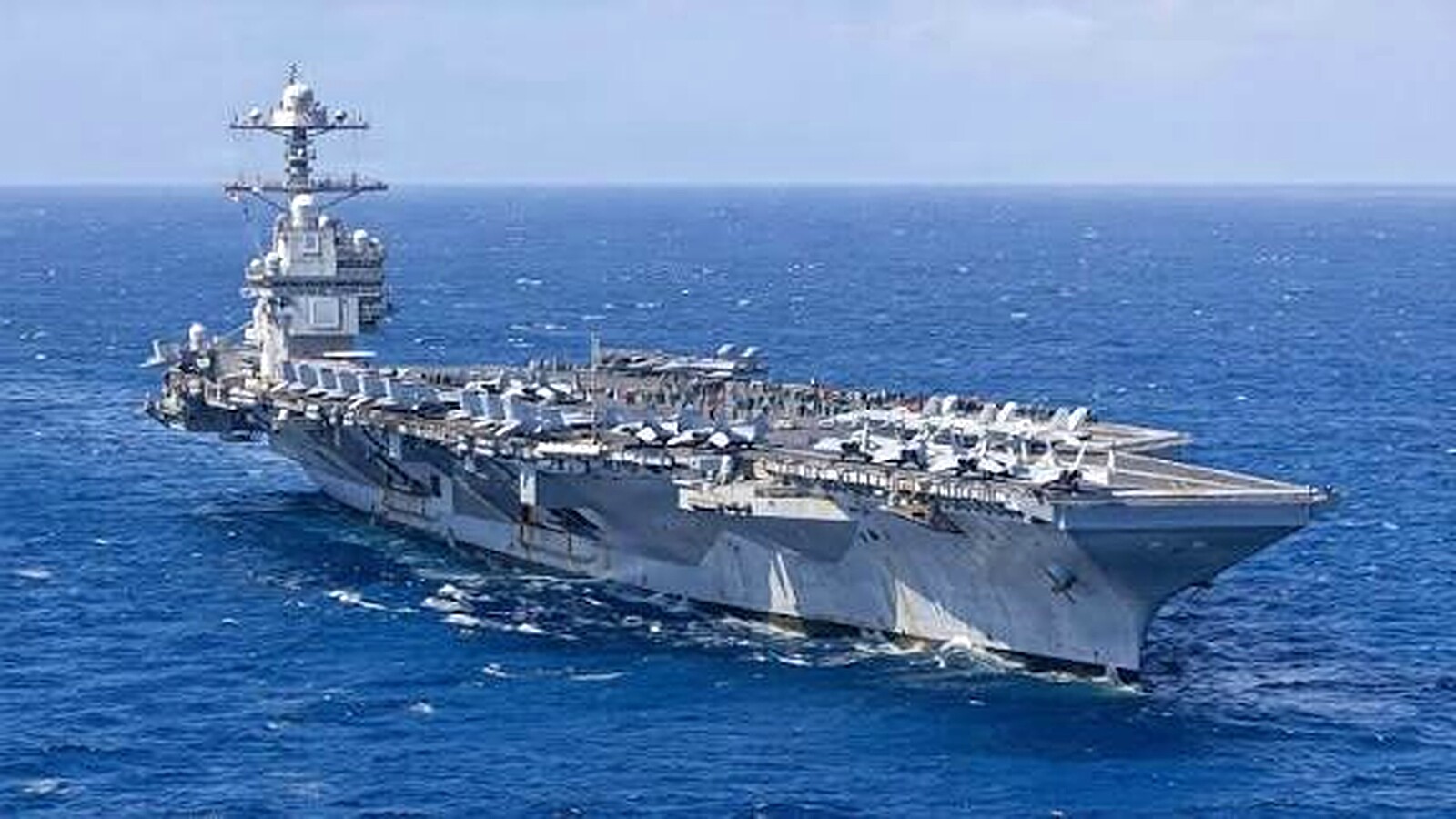
ISLAMABAD: Iran’s Islamic Revolutionary Guard Corps (IRGC) announced on Sunday that it launched four ballistic missiles at the US Navy aircraft carrier USS Abraham Lincoln, marking a dramatic escalation in the ongoing confrontation between Tehran and Washington.
The claim, broadcast through Iranian state media and reported by international outlets including Reuters, AFP, and BBC, described the action as part of “Operation True Promise 4.” The IRGC statement asserted that the missiles successfully struck the vessel, warning that “the land and sea will increasingly become the graveyard of the terrorist aggressors.”
This development follows a major joint US-Israeli military operation launched on Saturday against targets inside Iran. That campaign reportedly resulted in the death of Supreme Leader Ayatollah Ali Khamenei and inflicted significant damage on Revolutionary Guard facilities, nuclear-related sites, missile bases, and command structures in Tehran and other locations.
The USS Abraham Lincoln, a Nimitz-class nuclear-powered aircraft carrier, has been positioned in the Arabian Sea off the coast of Oman since mid-February 2026, according to verified satellite imagery from sources like BBC Verify. It forms the centerpiece of a US carrier strike group deployed to the region amid rising tensions over Iran’s nuclear program, ballistic missile capabilities, and support for regional proxies.
The carrier arrived in the US Central Command area in late January 2026 after redirection from Indo-Pacific duties. It operates alongside guided-missile destroyers and is supported by Carrier Air Wing 9, providing substantial air power projection. A second carrier, the USS Gerald R. Ford, has also moved toward the Middle East to bolster US presence, creating one of the largest naval concentrations in the region in recent decades.
Iran’s announcement came amid widespread missile and drone launches targeting US bases across the Gulf, including sites in Bahrain, Qatar, the UAE, and Kuwait. Reports indicate explosions and interceptions in multiple Gulf capitals, with air defenses in the UAE destroying hundreds of incoming projectiles since Saturday. Casualties have been reported in some areas from shrapnel during intercepts.
The IRGC framed the strike on the Lincoln as retaliation for the killing of Khamenei and attacks on Iranian sovereignty. State media emphasized a “new phase” of confrontation, vowing intensified operations against American and Israeli interests. No independent verification of damage to the carrier has emerged, and the US Navy has not issued public confirmation of any successful hit.
US military officials have previously highlighted the layered defenses protecting carrier strike groups, including fighter jets, destroyers equipped with Aegis systems, and electronic warfare capabilities. In early February 2026, an F-35 from the Lincoln strike group downed an approaching Iranian Shahed drone deemed a potential threat.
The incident unfolds against a backdrop of failed nuclear negotiations. The US has demanded zero uranium enrichment, curbs on ballistic missiles, and an end to proxy support, conditions Tehran has rejected as violations of sovereignty. President Donald Trump has warned of overwhelming force in response to any Iranian retaliation, stating that further aggression would trigger unprecedented consequences.
Regional allies have expressed concern over escalation. The UAE reported three deaths and the interception of numerous missiles and drones. Kuwait noted one fatality and power disruptions linked to Iranian strikes. Strikes have also affected civilian areas indirectly through defensive actions.
The IRGC’s ballistic missile arsenal includes models capable of ranges covering the Arabian Sea. However, hitting a moving naval target protected by advanced sensors and interceptors presents significant technical challenges. Analysts note that while Iran has demonstrated missile precision in past operations, success against a defended carrier remains unproven in combat.
Broader implications include risks to global energy markets, as the Strait of Hormuz lies nearby. Oil prices have already shown volatility amid the conflict. Diplomatic channels appear strained, with interim leadership in Iran focusing on internal transition while military responses continue.
The claim has drawn immediate international attention, with calls for de-escalation from various quarters. China described the initial strikes on Iran as a grave violation, while other powers monitor developments closely.
As the situation evolves, the absence of US confirmation leaves the strike’s outcome uncertain. Military experts suggest any direct hit would represent a major shift in asymmetric warfare capabilities, though layered US defenses make full success unlikely without substantial evidence.
The confrontation underscores the volatile mix of nuclear ambitions, regional rivalries, and superpower involvement in the Middle East, with potential for wider spillover if not contained.