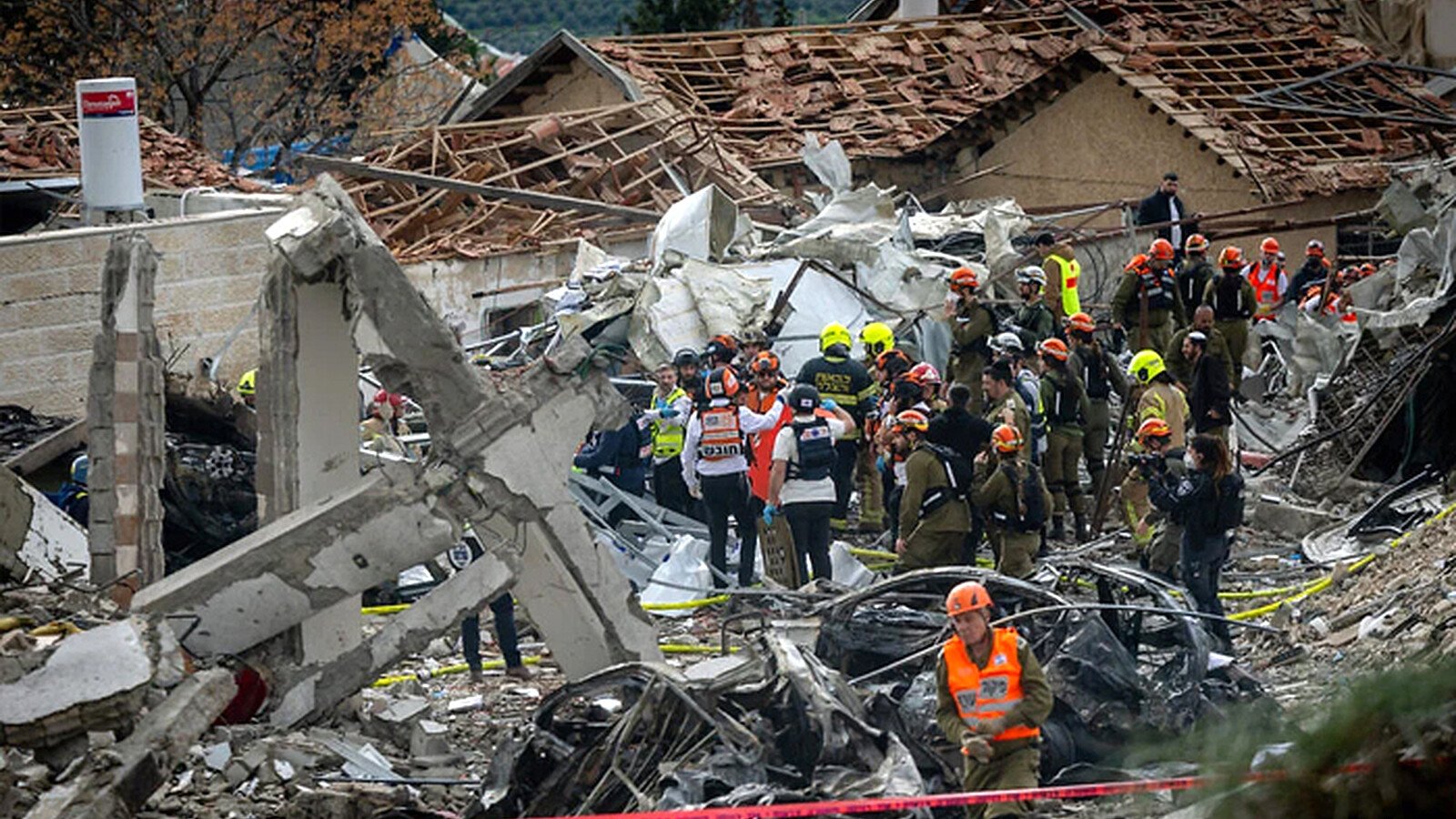
ISLAMABAD: An Iranian ballistic missile struck the central Israeli city of Beit Shemesh on Sunday, killing at least nine people and injuring 23 others in what has emerged as one of the deadliest single incidents on Israeli soil since the current escalation began.
The attack occurred amid a widening regional conflict triggered by joint United States and Israeli strikes on Iran that resulted in the death of Supreme Leader Ayatollah Ali Khamenei and other senior officials.
Israeli emergency services, including Magen David Adom, confirmed the rising death toll after initial reports of fewer casualties, with rescue teams extracting bodies from rubble throughout the day.
The missile achieved a direct impact on a residential area, severely damaging a public bomb shelter where many victims were sheltering at the time of the strike.
Jerusalem District Police Commander Avshalom Peled stated that the majority of those killed were inside the shelter when the ballistic missile hit, highlighting the vulnerability of such facilities.
Local authorities noted that the shelter sustained catastrophic damage, collapsing under the force of the impact and trapping occupants beneath debris.
Israeli media reported that the strike destroyed parts of surrounding homes and a synagogue, compounding the civilian toll in this city located about 30 kilometres west of Jerusalem.
Beit Shemesh, a growing urban centre with a significant religious population, has rarely featured in prior direct attacks, making this incident particularly shocking for residents.
Medical teams transported the injured to nearby hospitals, where two victims were listed in serious condition, three in moderate condition, and the rest with light injuries.
The attack formed part of a broader Iranian retaliatory barrage following the killing of Khamenei in US-Israeli operations that targeted Iranian leadership and military sites.
Iran launched multiple waves of missiles and drones toward Israel and US assets in the region, with many intercepted by Israeli air defences but at least one penetrating to cause significant harm in Beit Shemesh.
The incident underscores ongoing concerns about the effectiveness of public shelters against advanced ballistic missiles, a lesson drawn from earlier exchanges.
In June of the previous year, during prior clashes with Iran, Israeli police had already identified that common bomb shelters lacked the structural reinforcement needed to withstand direct ballistic impacts.
Deputy officials reiterated that public shelters were not engineered for such high-intensity strikes, a deficiency exposed tragically in this event.
Arab media outlets have highlighted the proximity of Beit Shemesh to sensitive Israeli installations, including nuclear-related facilities and other strategic sites in the broader area.
While no official confirmation links the strike specifically to those installations, the location raises questions about targeting priorities in Iran’s response.
The broader conflict has seen casualty figures climb rapidly on both sides, with Iranian sources reporting over 200 deaths from US-Israeli strikes, while Israel tallies civilian losses from retaliatory fire.
This Beit Shemesh strike stands out as the single highest casualty event in Israel during the current phase, prompting emergency declarations and heightened alerts across the country.
Search and rescue operations continued into the evening, with helicopters aiding in evacuations and first responders combing through collapsed structures for survivors.
Israeli officials have vowed continued operations against Iranian targets, describing the response as necessary to deter further aggression.
The episode illustrates the rapid spiral of escalation in the Middle East, where proxy conflicts have evolved into direct military confrontations involving major powers.
Civilian suffering remains at the forefront, with families in Beit Shemesh grieving losses in shelters meant for protection.
International observers warn that without de-escalation, further such incidents could draw in additional actors and widen the theatre of war.
As rescue efforts persist, the focus remains on supporting the affected families and assessing the full extent of damage in this once-quiet city near the capital.